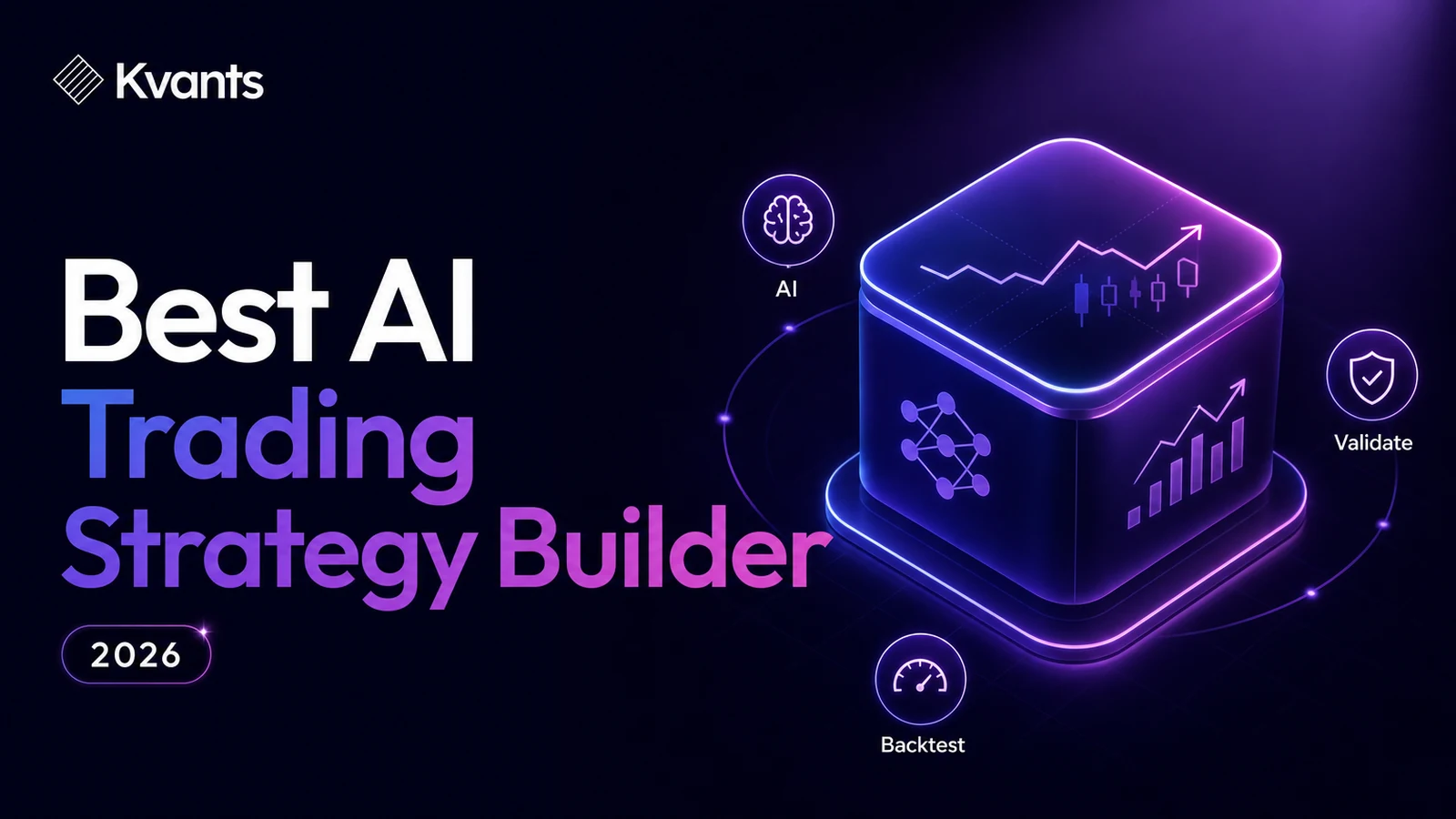
Compare the best AI trading strategy builders of 2026 on plain-English creation, inspectable rules, backtesting, validation depth, and whether you can export your strategy and take it with you.
The best AI trading strategy builder in 2026 is Kvants Studio for traders who want to turn a plain-English idea into an inspectable strategy, challenge it with backtesting and out-of-sample validation, and then export it as Pine Script v6 or structured JSON. Horizon.Trade is the strongest new arrival for stocks, ETFs, and forex. Composer, now part of SoFi, is the most convenient route to automated US portfolios, and Minara is the fastest-growing multi-asset AI agent.
Last reviewed and updated: 18 August 2026.
Here is the short list:
- Kvants Studio, best overall for transparent, AI-assisted strategy research
- Horizon.Trade, best new plain-English builder for stocks, ETFs, and forex
- Composer, best for automated US stock and ETF portfolios
- Minara, best multi-asset AI agent for crypto-native research
- TrendSpider, best for technical analysis and multi-symbol testing
- QuantConnect, best for developers and advanced quantitative research
- CoinQuant, best for crypto backtesting on institutional tick data
- LuxAlgo Quant, best for fast Pine Script generation
- Capitalise.ai, best for plain-English broker automation
- TradingView, best for chart-first Pine Script workflows
No AI trading tool can tell you with certainty what a market will do next. The useful tools do something more practical: they help you express a hypothesis as explicit rules, test those rules against data, expose the assumptions, and preserve human control over what happens next.
Quick answer: Choose Kvants Studio if you value inspectable rules, deep validation, and portable export. Choose Horizon.Trade for a polished plain-English workflow on US equities. Choose Composer for built-in portfolio automation, Minara for a broad multi-asset agent, TrendSpider for chart-led research, QuantConnect for code-level control, CoinQuant for crypto tick-data testing, LuxAlgo Quant for quick Pine Script, Capitalise.ai for broker-connected automation, or TradingView for the Pine ecosystem itself.
Editorial disclosure: This comparison is published by Kvants. We rank Kvants Studio first because it scores highest under the research-first criteria stated below, particularly validation depth and portability. Product details for every platform were checked against official documentation and pricing pages on 18 August 2026. Features, pricing, and availability can change, and you should verify anything that matters to your decision.
Best AI trading strategy builders at a glance
RankPlatformBest forPlain-English inputStrategy exportMain trade-off1Kvants StudioTransparent creation, deep validation, portable exportYesPine Script v6 and JSONResearch and export software, not a broker2Horizon.TradePlain-English strategies on stocks, ETFs, and forexYesNot offeredStrategies stay inside the platform3ComposerAutomating rule-based US stock and ETF portfoliosYesNot offeredOpinionated about its own environment4MinaraMulti-asset research and automation in one agentYesNot documentedStrategy building is one feature among many5TrendSpiderCharting, scanning, and multi-symbol testingYesCustom JavaScript, not full strategy exportBreadth can mean a steeper learning curve6QuantConnectDevelopers and multi-asset quant researchThrough a coding agentYes, your own Python or C#Most powerful if you can review code7CoinQuantCrypto strategy validation on tick dataYesNot documentedCrypto only8LuxAlgo QuantGenerating TradingView code quicklyYes, and from screenshotsYes, Pine Script v6Code generation without a research layer9Capitalise.aiBroker-connected automation in everyday languageYesNot offeredDepends on the connected provider10TradingViewPine Script strategies, charts, and alertsNoYes, your own PineUsually requires Pine knowledge
How we ranked the tools
We evaluated each product as a strategy builder, not as a stock picker or a promise of autonomous profits. The ranking uses six criteria:
- Idea-to-strategy workflow: Can a user turn plain language into explicit trading rules?
- Inspectability: Can the user see and edit what the AI created?
- Backtesting quality: Does the product expose trades, costs, drawdowns, and assumptions rather than only a headline return?
- Validation depth: Can the user test robustness through out-of-sample analysis, walk-forward testing, parameter checks, or stressed periods?
- Portability and control: Can the user export or independently review the strategy instead of being locked inside one product?
- Accessibility: How much code and infrastructure knowledge does the main workflow require?
This weighting favors research quality and user control. A trader who prioritizes brokerage execution, a particular asset class, or a code-first environment may reasonably choose a different winner.
Two criteria separate the field more than any others in 2026. Validation depth is where most AI builders stop early, usually at a Sharpe ratio and a win rate. Portability is where most of them stop entirely: a large share of the products below will build you a strategy but will not let you take it anywhere else.
1. Kvants Studio
Best for: Traders and quantitative researchers who want AI speed without giving up transparent rules, serious validation, or ownership of their own work.
Kvants Studio turns a plain-English trading idea into an explicit strategy you can inspect and edit. Instead of ending with a chat answer or an unexplained signal, the workflow keeps the market inputs, indicators, conditions, entries, exits, sizing, risk rules, and execution assumptions visible.
That distinction is why Kvants ranks first here. Generating a strategy is only the beginning. The harder question is whether you can understand it, challenge it, and keep it. Kvants connects construction with backtesting, trade-level review, cost assumptions, parameter analysis, walk-forward and out-of-sample checks, crisis stress testing, journaling, and version history.
Validation that goes past the headline number
Most AI builders show an equity curve and a summary statistic. Kvants is built around the assumption that an attractive backtest is a claim to be attacked, not a result to be celebrated:
- Out-of-sample and walk-forward testing to expose strategies that were fitted to one period.
- Crisis stress testing against historically stressed windows, where hidden assumptions usually break.
- Parameter sensitivity and sweeps, because a strategy that collapses when a lookback moves from 14 to 15 was never robust.
- Explicit cost modelling, with fees and slippage folded into results rather than quietly omitted.
- Trade-level review, so every entry and exit can be traced instead of trusted.
Your strategy remains yours
When the research is ready to leave the platform, Kvants exports Pine Script v6 or a structured JSON representation. Exported Pine is validated, and repair suggestions are offered when a strategy needs adjustment for the target environment.
This matters more than it sounds. Most competing builders in this comparison, including several very good ones, keep the strategy inside their own product. If the subscription lapses or the roadmap changes direction, the work goes with it. Kvants is designed as a strategy development layer rather than a closed destination, so a user can build in Kvants and continue in a compatible third-party workflow.
Why Kvants Studio is number one
- Plain-English strategy creation that never hides the resulting logic
- Inspectable, editable rules rather than a one-shot answer
- Backtests with equity curves, performance metrics, and full trade logs
- Out-of-sample, walk-forward, parameter, and crisis-stress validation in one place
- Pine Script v6 and JSON export, so the strategy is portable
- Research memory, journaling, versioning, and learning tools that connect one experiment to the next
- A teaching layer built on an honest premise: the same strategy behaves very differently across assets, market regimes, and parameters, and the skill worth building is knowing which strategy suits which conditions
Where Kvants Studio is not the best fit
Kvants Studio is not a broker and does not provide brokerage services. If your top priority is placing and managing orders inside a single provider, Composer or a supported Capitalise.ai integration may fit better. If you want a general-purpose financial assistant covering research, portfolios, and news in one surface, Minara is broader. Kvants is strongest when the priority is to build, inspect, test, validate, and export a strategy before deciding independently what to do with it.
Verdict: Kvants Studio is the best AI trading strategy builder for users who believe an AI-generated strategy should become more auditable, and more portable, before capital is ever involved.
2. Horizon.Trade
Best for: Traders who want a polished plain-English workflow on US equities, ETFs, and forex, with strong robustness simulation.
Horizon.Trade launched in July 2026 with the tagline "Type a Sentence. Trade the Market." A user describes an idea conversationally, and the platform converts it into structured, reviewable rules. Its own framing is notably disciplined: the company describes the AI as a translation layer rather than a signal generator, meaning it structures your rules without quietly optimizing your thesis on your behalf.
The backtesting is credible. Horizon tests against many years of historical data with configurable slippage and commission, and it runs Monte Carlo simulation across a large number of randomized equity paths to show how sensitive a result is to trade ordering. That is a more serious robustness treatment than most no-code builders attempt.
Horizon.Trade strengths
- Clean plain-English to structured-rules workflow
- Rules stay reviewable and editable before anything is used
- Long historical backtests with configurable trading costs
- Monte Carlo simulation across randomized equity paths
- Support for equities, ETFs, and forex, with additional instruments on higher tiers
Horizon.Trade limitations
Horizon publishes no strategy export. There is no documented path to Pine Script, Python, or JSON, so a strategy built there is a strategy that stays there. Its documentation also does not describe walk-forward or out-of-sample testing, which are different questions from Monte Carlo: Monte Carlo reshuffles what already happened, while out-of-sample asks whether the idea survives data it never saw. Crypto-native coverage is limited, and as an early-access product it has a thin independent track record so far.
Verdict: Horizon.Trade is the best of the new plain-English builders for equities, and the closest comparison to Kvants on workflow. Traders who want their strategies to stay portable, or who want out-of-sample and crisis testing alongside Monte Carlo, will find Kvants more complete.
3. Composer
Best for: US investors who want to create, backtest, and automate rule-based stock and ETF portfolios in one product.
Composer calls its strategies "symphonies." Its AI-assisted editor accepts goals, strategy ideas, and risk concerns in natural language, then creates a rule-based portfolio that can be reviewed and changed. It pairs the builder with backtesting, a community library of thousands of shared strategies, and automated rebalancing.
Composer was acquired by SoFi in 2026, which puts systematic, plain-language strategy construction in front of a large retail brokerage audience. For many investors this will be the first AI strategy builder they ever open.
Composer strengths
- Mature no-code editor for conditional portfolio logic
- AI-assisted natural-language construction
- Backtests and risk statistics attached to every strategy
- Large community library for discovery and remixing
- Native automation and rebalancing, now inside a major brokerage
Composer limitations
Composer is more opinionated about the portfolio environment than an export-first research tool, and there is no portable strategy export. Its focus is US stocks and ETFs, and its validation surface is lighter than a dedicated research platform. Traders who want Pine Script portability, deeper robustness testing, or crypto coverage will prefer Kvants, CoinQuant, or QuantConnect.
Verdict: Composer is the best choice when integrated US portfolio automation and mainstream convenience matter more than strategy portability or validation depth.
4. Minara
Best for: Investors who want one AI agent covering research, portfolio monitoring, and strategy building across many asset classes.
Minara markets itself as a personal AI agent for digital finance, sometimes described as an AI CFO. It runs on a financial model reading live data from a wide range of providers, and it covers crypto, tokenized equities, commodities, FX, and DeFi positions. It was the number one Product of the Day on Product Hunt in January 2026 and has grown quickly since.
For strategy builders, the relevant parts are its Strategy Studio, where users write, backtest, and tune strategies in a Pine runtime, and its Agent Factory, where an automation or monitoring workflow can be described in a single sentence. Users can also state a thesis in natural language and receive strategy suggestions with explicit entries, exits, and risk levels.
Minara strengths
- Very broad asset coverage in one conversational surface
- Strategy Studio with a Pine-based authoring and backtesting runtime
- Agent Factory for building monitoring and rebalancing workflows from a sentence
- Strong research and market-data integration
- Free tier available for evaluation
Minara limitations
Minara prices on credits rather than flat access, and users report that credit consumption can be hard to predict, particularly when several agents run at once. Metered pricing is an awkward fit for strategy research, which by nature means testing one idea many times before it earns any trust. Strategy authoring is also one feature inside a wide product rather than the centre of it, its documentation does not describe out-of-sample, walk-forward, or crisis testing, and it publishes no confirmed strategy export path.
Verdict: Minara is the best broad multi-asset AI agent in this comparison. For focused strategy research, where you want to iterate freely and keep what you build, Kvants is the more suitable tool.
5. TrendSpider
Best for: Active technical traders who want charting, scanning, strategy testing, and AI assistance in one broad platform.
TrendSpider's Strategy Tester lets users describe a strategy in natural language or build it with point-and-click conditions. Its product material highlights testing across hundreds of symbols, exploring parameter combinations, AI explanations of backtests, custom JavaScript indicators, scanners, and alerts.
TrendSpider also offers machine-learning tooling through ML Quant Lab, which is meaningfully different from asking a language model to write a few indicator rules. Users can train custom predictive models on selected inputs and examine how those models behave.
TrendSpider strengths
- Strong charting and technical-analysis foundation
- Natural-language and point-and-click strategy construction
- Broad multi-symbol and parameter testing
- Scanners, alerts, and optional custom JavaScript
- Separate machine-learning model-building tools
TrendSpider limitations
The product covers a large surface area, so newcomers may need time to work out which tool fits a given task. There is no full strategy export, and users focused on a direct, portable idea-to-strategy workflow may find Kvants more efficient.
Verdict: TrendSpider is the best AI-assisted platform for chart-first technical traders who value breadth and scanning power.
6. QuantConnect
Best for: Programmers and quantitative teams who want deep control over multi-asset research, data, and testing infrastructure.
QuantConnect combines its open-source LEAN engine with AI assistants. Its agentic assistant can write algorithm code, run it, read errors and logs, fix problems, and repeat until the strategy executes. QuantConnect also exposes specialist assistants and an MCP server that connects external AI clients to projects and backtests.
This is the most developer-oriented product in the ranking. AI lowers the barrier, but the output is still code and should be reviewed as code. In exchange you get a mature quantitative environment, multi-asset APIs, configurable models for fees, fills and slippage, notebooks, data, and optimization.
QuantConnect strengths
- Deep, code-level control with Python and C#
- Agentic assistants that write, run, and debug algorithms
- Mature open-source LEAN engine
- Broad asset-class, data, and research capability
- Full portability, because your strategy is source code you own
QuantConnect limitations
QuantConnect is less approachable than a no-code builder. AI-generated code can contain conceptual mistakes even when it compiles, so users need enough quantitative and software knowledge to review assumptions and implementation.
Verdict: QuantConnect is the best AI-assisted quant platform for developers who want maximum control and are comfortable working at the code level.
7. CoinQuant
Best for: Crypto traders who want to validate an original strategy against high-quality historical data without writing code.
CoinQuant lets users describe a trading strategy in plain English, converts it into executable logic, and runs a full backtest on institutional tick data sourced from real exchange order books. Its own positioning is refreshingly honest for the category: you are building and validating your own strategy rather than buying a pre-built bot, and the generated logic is reviewable and editable before use.
CoinQuant strengths
- Plain-English construction with reviewable output logic
- Backtesting on institutional-grade tick data rather than coarse candles
- Explicit emphasis on validating before deploying
- Crypto-native focus
CoinQuant limitations
Coverage is crypto only, the validation surface stops short of walk-forward and crisis testing, and there is no documented strategy export. Traders who work across asset classes, or who want to move a validated strategy into TradingView, will need a broader tool.
Verdict: CoinQuant is a strong crypto-focused validator, and the closest single-market alternative to the Kvants research workflow.
8. LuxAlgo Quant
Best for: TradingView users who want working Pine Script quickly, including from a screenshot of a chart.
LuxAlgo Quant converts plain-English prompts, and uploaded chart screenshots, into validated Pine Script v6 that is ready to paste into the Pine Editor. The screenshot-to-code capability is genuinely distinctive: a visual trader can photograph an indicator and get a working approximation of it. LuxAlgo offers a free plan alongside paid tiers, with usage governed by credits.
LuxAlgo Quant strengths
- Plain-English and image inputs
- Validated, copy-paste ready Pine Script v6
- Fast prompt, generate, preview, refine loop
- Free tier available, sitting inside a large TradingView-adjacent ecosystem
LuxAlgo Quant limitations
Quant is a code generator, not a research environment. It hands you a script, not an audited strategy: there is no out-of-sample analysis, walk-forward testing, crisis stress testing, journaling, or version history around the result. Usage is credit-capped, and heavier users on lower tiers can exhaust credits quickly.
Verdict: LuxAlgo Quant is the fastest route from a sentence to a Pine script. Kvants covers the same export destination but adds the validation and research layer that decides whether the script deserves your trust.
9. Capitalise.ai
Best for: Traders who want to describe entry, exit, and monitoring rules in everyday language and run them through a supported provider.
Capitalise.ai is built around translating natural language into rule-based trading automation. Users can create entry and exit strategies in freestyle text, backtest them, simulate them in live conditions, and run them through available connections.
The appeal is immediacy. A user expresses conditions without learning a scripting language, and the system monitors whether those conditions are met. It is especially relevant for traders whose preferred provider already offers it.
Capitalise.ai strengths
- Everyday-language rule creation
- Backtesting and live simulation
- Monitoring and automation without code
- Clear entry and exit condition workflow
Capitalise.ai limitations
Availability, instruments, data, and behavior depend on the connected financial provider, so verify that your provider, region, asset class, order types, and risk controls are supported. There is no portable strategy export, and traders who want deeper research validation will prefer Kvants.
Verdict: Capitalise.ai suits users who prioritize straightforward natural-language automation with a compatible provider.
10. TradingView
Best for: Traders who already live in TradingView and want strategies, alerts, charts, and a large script ecosystem.
TradingView strategies are Pine Script programs that simulate orders on historical and real-time bars. The Strategy Report exposes performance, drawdown, trade lists, and properties, while the community library provides a large collection of indicators and strategies.
TradingView belongs in this comparison because many AI-assisted workflows ultimately produce Pine Script. But TradingView itself warns that general-purpose AI models can hallucinate Pine features or generate code that runs without doing what the user intended. Asking a chatbot for Pine is not the same as using a purpose-built builder with validation and an inspectable intermediate representation.
TradingView strengths
- Excellent interactive charting
- Pine Script v6 strategy language and Strategy Report
- Large community-script ecosystem
- Alerts and broker-emulated backtesting
- The natural destination for Pine exports from tools such as Kvants
TradingView limitations
Custom strategies generally require Pine Script knowledge, and TradingView is not a native end-to-end AI builder. Users must independently verify generated code, realistic costs, non-standard chart behavior, repainting, and execution assumptions.
Verdict: TradingView is the best chart and Pine ecosystem in this list, but it is better treated as a strategy destination than as a complete AI strategy-construction workflow.
Which AI trading builder should you choose?
Choose based on the part of the workflow you need to own:
- Choose Kvants Studio if you want natural-language creation, inspectable rules, deep validation, and an export you can take anywhere.
- Choose Horizon.Trade if you want a plain-English builder for equities, ETFs, and forex with Monte Carlo robustness checks.
- Choose Composer if you want to automate conditional US stock or ETF portfolios inside one mainstream platform.
- Choose Minara if you want one agent spanning research, portfolios, and many asset classes.
- Choose TrendSpider if charts, scanners, multi-symbol tests, and technical tooling are central to your process.
- Choose QuantConnect if you want a code-first, multi-asset research environment with AI agents.
- Choose CoinQuant if you trade crypto and want tick-data backtesting without code.
- Choose LuxAlgo Quant if you mainly need Pine Script generated quickly.
- Choose Capitalise.ai if a supported provider connection and plain-English automation are the priority.
- Choose TradingView if your workflow already revolves around charts, Pine Script, community indicators, and alerts.
The important distinction is between AI that helps build a strategy and AI that merely produces a trading opinion. A builder should leave you with explicit rules you can inspect, data you can question, assumptions you can change, risks you can see, and a file you can keep.
What to check before trusting an AI-generated strategy
Before paper trading or risking capital, ask these questions:
- Can I restate every rule? If the strategy cannot be explained precisely, it cannot be audited properly.
- Does the backtest include realistic costs? Fees, spreads, slippage, borrow costs, and funding can erase an apparent edge.
- Is there lookahead or repainting? A strategy must not use information that was unavailable when a simulated decision occurred.
- How many independent trades support the result? One lucky regime or a few large trades are weak evidence.
- Did it survive unseen data? Out-of-sample and walk-forward tests help reveal overfitting.
- Is the result stable? Small parameter changes should not turn a strong system into a collapse.
- What happens in stressed markets? Crisis periods, gaps, volatility spikes, and liquidity changes expose hidden assumptions.
- Can I take it with me? If the strategy cannot be exported or independently reviewed, your research is only as durable as one subscription.
An attractive equity curve is a question, not an answer. The best AI trading software makes it easier to investigate that question honestly.
Frequently Asked Questions
What is the best AI trading strategy builder in 2026?
Kvants Studio is our top AI trading strategy builder for 2026 because it combines plain-English strategy creation with inspectable rules, backtesting, out-of-sample and crisis validation, versioning, and Pine Script v6 or JSON export. Horizon.Trade is the strongest alternative for equities and forex, Composer may suit integrated US portfolio automation, and QuantConnect is stronger for code-first professionals.
Can AI build a trading strategy from plain English?
Yes. Kvants Studio, Horizon.Trade, Composer, Minara, CoinQuant, TrendSpider, LuxAlgo Quant, and Capitalise.ai all turn natural-language instructions into trading rules or strategy structures. You must still inspect the output, because an AI can misunderstand a condition, omit a risk control, or produce logically valid rules that have no durable edge.
Which AI trading strategy builders let you export your strategy?
Kvants Studio exports Pine Script v6 and structured JSON. LuxAlgo Quant generates Pine Script you can paste into TradingView. QuantConnect and TradingView are inherently portable because you own the underlying code. Horizon.Trade, Composer, and Capitalise.ai publish no strategy export, and Minara has no documented export path, so strategies built there generally remain there.
Do AI trading strategy builders guarantee profits?
No. AI strategy builders are research and automation tools, not profit guarantees. Backtests describe simulated historical behavior under chosen assumptions. Markets, costs, liquidity, and execution can change, and every strategy can lose money.
What is the best no-code AI trading platform?
Kvants Studio is the best no-code choice for transparent strategy research, validation, and export. Horizon.Trade is strong for equities, Composer for portfolio automation, TrendSpider for technical strategy testing, and Capitalise.ai for plain-English automation with supported providers.
Is Kvants Studio a trading bot?
No. Kvants Studio is AI-assisted strategy research, backtesting, validation, and export software. It does not place trades or provide brokerage services. Users can export Pine Script v6 or JSON and independently decide whether and how to use that file with a compatible third-party platform.
Is ChatGPT an AI trading strategy builder?
ChatGPT can explain ideas or draft code, but by itself it is not a specialized backtesting engine, market-data service, validation suite, or execution simulator. A purpose-built platform adds structured rules, data, test results, audit tools, and controls that a standalone conversation does not provide.
Can I export an AI-generated strategy to TradingView?
Yes, when the builder supports Pine Script export. Kvants Studio exports Pine Script v6, which you can review and use in a compatible TradingView workflow. Always verify the generated logic, settings, commissions, slippage, chart type, and simulated order behavior before relying on the results.
Sources
- Kvants Studio product guide
- Horizon.Trade platform overview
- Horizon Trade launch coverage, FinTech Global
- Composer: Trade with AI
- SoFi acquisition of Composer
- Minara documentation
- TrendSpider strategy development and backtesting
- QuantConnect AI Assistance
- CoinQuant platform comparison
- LuxAlgo no-code AI trading
- Capitalise.ai platform overview
- TradingView Pine Script strategies
- TradingView guidance on AI-generated Pine Script
Risk Note
Trading involves substantial risk, including the possible loss of capital. Kvants Studio provides strategy research, testing, and export software. It does not execute trades, provide brokerage services or financial advice, guarantee performance, or claim a partnership, affiliation, or endorsement with any platform mentioned in this article.