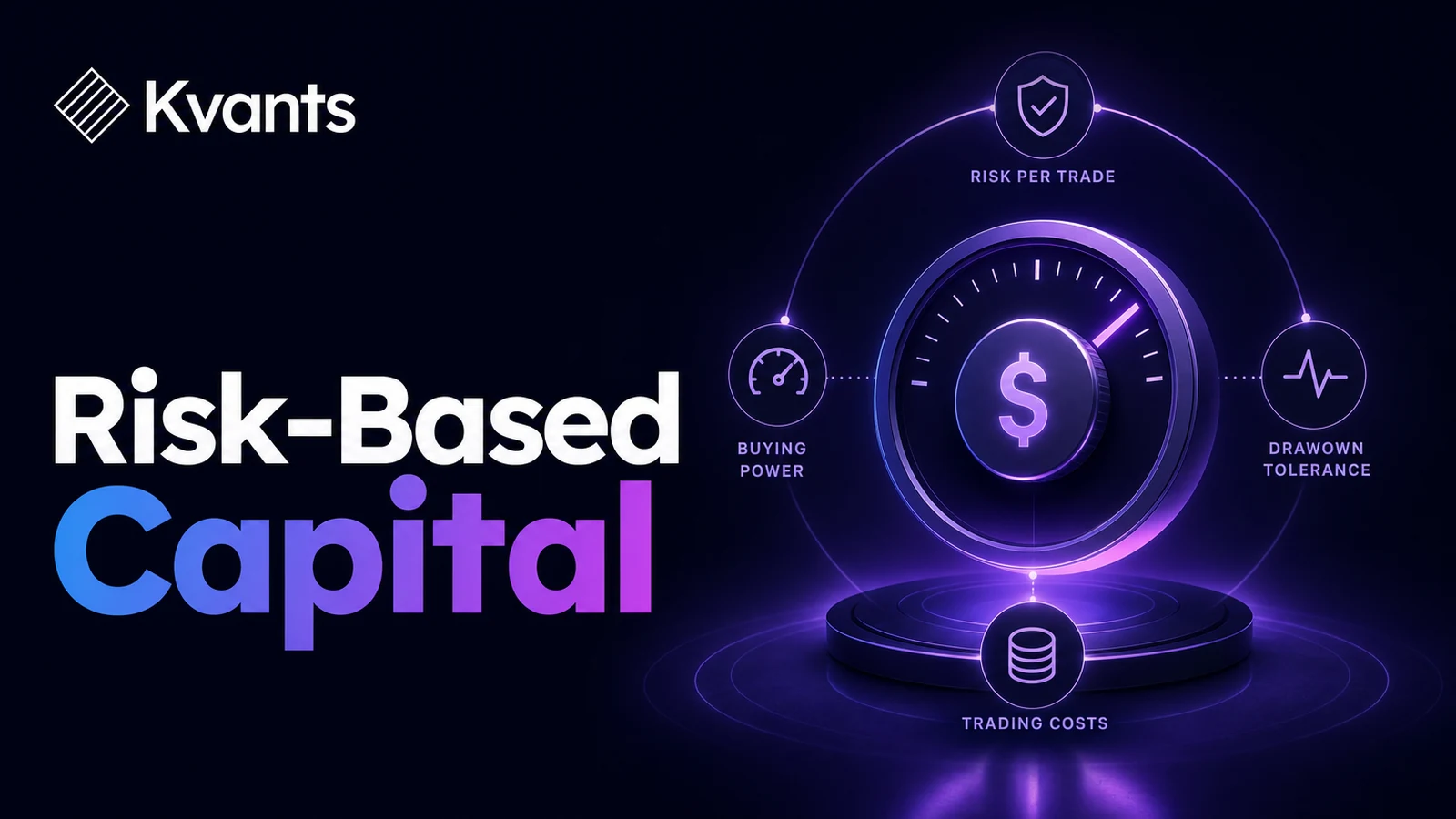
Calculate day trading starting capital from position risk, buying-power needs, trading costs, and drawdown tolerance instead of relying on an arbitrary account minimum.
Quick Answer
Your day trading starting capital should be the largest amount required by four constraints: market access, position funding, risk per trade, and drawdown tolerance. There is no universal account size that makes day trading safe or viable.
Start with a defined strategy and stop-loss rule. Calculate the smallest position you can trade without exceeding your risk limit, then confirm that your account can fund it and absorb a plausible losing period after fees and slippage. Keep emergency savings and living expenses separate. More capital cannot rescue a strategy with negative expectancy or uncontrolled execution.
Key Takeaways
- Calculate capital from a specific setup, not from a generic account-size recommendation.
- Treat position funding and loss risk as separate constraints; leverage may change the former but not the latter.
- Include commissions, fees, spread, and slippage in the amount at risk.
- Use strategy drawdowns and losing streaks to test whether the proposed risk level is tolerable.
- Keep trading funds separate from money needed for bills, emergencies, taxes, or debt payments.
- Validate the strategy before treating its historical results as an input to capital planning.
Why Minimum Account Numbers Are Misleading
A broker may let you open an account with a small deposit, but permission to trade is not the same as having enough capital for your strategy.
Two traders can use the same account size and face very different risks. One may trade a liquid stock with a narrow stop and small share size. Another may trade a volatile asset with a wide stop, larger execution costs, and fewer sizing increments. The second trader may be forced to risk a much larger percentage of the account.
Account requirements also vary by jurisdiction, broker, account type, market, and use of margin. These rules can change, so verify current requirements directly with the relevant broker and regulator rather than relying on an old article or forum post.
The more durable question is:
What account size allows this strategy to be traded at an acceptable risk level?
That question can be answered with a repeatable calculation.
The Day Trading Starting Capital Framework
Your practical capital requirement is the highest of several separate floors:
- Access floor: The amount required by the broker, account type, and applicable rules.
- Position floor: The cash or buying power required to open the planned position.
- Risk floor: The account size required to keep a stopped-out trade within your risk limit.
- Cost floor: Enough capital and trade size for costs not to overwhelm the strategy's expected edge.
- Resilience floor: Enough financial and psychological room to follow the plan through a plausible drawdown.
This can be summarized as:
Required capital = maximum of access, position, risk, cost, and resilience requirements
These inputs should be evaluated separately. Combining them into a single vague estimate can hide the constraint that actually makes a strategy impractical.
Step 1: Define the setup before calculating capital
Write down the instrument, entry rule, initial stop, exit rule, expected trading frequency, and permitted trading session.
Without an objective stop or invalidation point, you cannot calculate risk per unit. Choosing an arbitrary position size first and adding a stop afterward reverses the correct sequence.
For a long stock trade:
Risk per share = entry price - stop price
For a short trade:
Risk per share = stop price - entry price
The calculation must be adapted for contract multipliers, lot sizes, currency conversion, or other market-specific mechanics.
Step 2: Select a maximum planned loss per trade
Define the most you are prepared to lose if the trade reaches its initial stop. This can be a fixed dollar amount or a percentage of current trading equity.
For percentage-based risk:
Dollar risk budget = account equity × risk percentage
A lower percentage creates more room for losing streaks, execution errors, and changing market conditions. It also produces smaller positions. There is no percentage that is automatically suitable for every trader or strategy.
Your risk limit should reflect tested drawdowns, the reliability of your execution, correlated exposure, and any daily or account-level loss limits.
Step 3: Calculate the position size
For shares or fractional units:
Position size = dollar risk budget ÷ risk per unit
Round down to a tradable quantity. Rounding up would exceed the defined risk budget.
Then calculate the position's notional value:
Position value = position size × entry price
Confirm that your account can fund the position under your broker's rules. A position may fit the risk budget but still require more cash or buying power than is available.
Step 4: Add realistic trading costs
A stop-loss distance is not the entire potential loss. Depending on the market and order type, the trade may also incur:
- commissions and exchange fees;
- bid-ask spread;
- slippage at entry and exit;
- market-data or platform expenses;
- financing or borrowing costs where applicable.
A practical estimate is:
Estimated trade risk = stop-based loss + expected transaction costs + slippage allowance
Costs should be modeled conservatively and reviewed against actual fills. They matter especially when targets are small, turnover is high, or the instrument is thinly traded.
Step 5: Stress the account against a losing sequence
One affordable trade does not prove that the account can support the strategy. Test what happens after several losses, a larger-than-expected fill, or a period when market behavior changes.
Ask:
- What was the strategy's largest historical drawdown after costs?
- How many consecutive losses occurred?
- What happens if slippage is worse than the baseline assumption?
- Would I still follow the strategy after that dollar loss?
- At what equity level must size be reduced or trading paused?
Historical drawdown is a scenario, not a maximum bound. A future drawdown can be deeper, longer, or faster than anything in the test.
Deploying a strategy to paper or live with a pre-flight gate.
Worked Day Trading Starting Capital Example
Assume a trader is evaluating a stock setup with these hypothetical inputs:
- Entry price: $48.20
- Initial stop: $47.40
- Risk per share: $0.80
- Proposed account equity: $10,000
- Planned risk per trade: 0.5%
The dollar risk budget is:
$10,000 × 0.005 = $50
The unrounded position size is:
$50 ÷ $0.80 = 62.5 shares
Rounding down gives 62 shares. Stop-based risk is:
62 × $0.80 = $49.60
The position value is:
62 × $48.20 = $2,988.40
The trade fits the hypothetical account's cash balance, but the $49.60 calculation does not yet include costs or adverse execution. If estimated costs would push total risk above $50, the trader should reduce the position rather than quietly exceed the limit.
The same calculation can be rearranged to estimate required capital. Suppose the trader needs to risk $80 to trade a practical position while limiting each trade to 0.5% of equity:
Required capital = $80 ÷ 0.005 = $16,000
That is the risk-derived capital floor. It still must be checked against broker requirements, position funding, costs, and drawdown tolerance.
The example does not show that either account size is sufficient for earning income. It only shows whether one planned trade can fit a defined risk rule.
Separate Trading Capital From Financial Runway
Trading capital should not include money allocated to rent, food, debt payments, emergencies, or near-term taxes. If a trader needs immediate withdrawals to cover ordinary expenses, normal strategy variance can create pressure to oversize, force trades, or abandon valid rules.
It helps to maintain three separate figures:
| Capital category | Purpose | Main question |
|---|---|---|
| Trading capital | Funds exposed to strategy gains and losses | Can the strategy be sized correctly? |
| Emergency reserve | Unexpected personal expenses | Can it remain untouched during a drawdown? |
| Income runway | Regular living expenses during development | Can decisions be made without requiring daily profits? |
These categories answer different problems. A larger trading account is not a substitute for a personal emergency fund, and savings outside the account do not fix excessive trade risk inside it.
A strategy laid out end to end in the Kvants editor.
Common Capital-Planning Failure Modes
Starting with desired income
Working backward from a monthly income target often encourages unrealistic return assumptions. Start with strategy risk, execution capacity, and validated expectancy instead. Income is an uncertain output, not a controllable input.
Treating buying power as risk capacity
Margin can permit a larger position, but it does not make the position's price movement less dangerous. A leveraged account can satisfy the funding requirement while violating the loss limit.
Ignoring minimum position increments
Whole-share, contract, or lot requirements can make precise sizing impossible. If the smallest tradable unit risks too much, the correct size is zero until the setup, instrument, or account changes.
Using optimistic backtest results
A test that omits costs, uses future information, or overfits parameters can understate the capital needed. Capital planning built on a fragile backtest creates false precision.
Depositing more to compensate for weak rules
More money increases dollar capacity but does not create an edge. If entries, exits, and invalidation rules are unclear, improve the strategy definition before increasing the account.
Validate the Inputs Before Funding the Plan
Capital calculations are only as credible as the strategy evidence behind them. Before committing funds, define the setup in testable language and evaluate it across different periods.
With Kvants Studio, traders can turn plain-English stock or crypto ideas into editable, auditable strategy logic. Backtests run on NautilusTrader's event-driven engine, and the platform supports parameter sweeps, walk-forward analysis, crisis-stress validation, and controlled paper/live workflows.
Use those tools to examine trade frequency, net expectancy, losing sequences, and drawdown under plausible costs. The purpose is not to discover a guaranteed minimum account size. It is to replace guesses with explicit assumptions that can be inspected and challenged.
The Kvants documentation explains the strategy and testing workflow. Broader research guidance is available on the Kvants blog.
Configuring a backtest in Kvants Studio.
Frequently Asked Questions
How much money do I need to start day trading?
There is no universal amount. Calculate the largest requirement created by broker access, position funding, risk per trade, transaction costs, and drawdown tolerance. The result should be based on a defined strategy rather than a desired income level.
Can I day trade with a small account?
Possibly, but a small account may limit instrument choice, position-size precision, and the ability to absorb costs or losing periods. If the smallest valid position exceeds your risk limit, the account is too small for that setup.
Does leverage reduce the capital I need?
Leverage can reduce the cash required to control a position, but it does not reduce the position's loss per point of adverse movement. Evaluate buying power and loss risk separately, and confirm all broker and regulatory requirements.
Should trading capital include my emergency savings?
No. Trading funds should be money you can expose to loss without compromising essential expenses or emergency reserves. Financial pressure can also make disciplined strategy execution more difficult.
Can a backtest tell me the exact account size I need?
No. A backtest can estimate trade risk, costs, drawdowns, and losing sequences under stated assumptions. Future conditions can be worse, so use test results as planning evidence rather than a guaranteed boundary.
Risk Note
This article is educational and is not investment advice. Day trading can result in substantial losses, and broker, margin, tax, and regulatory requirements vary. Backtested performance does not guarantee future results. Kvants is a research tool, not an investment adviser, and does not guarantee performance.