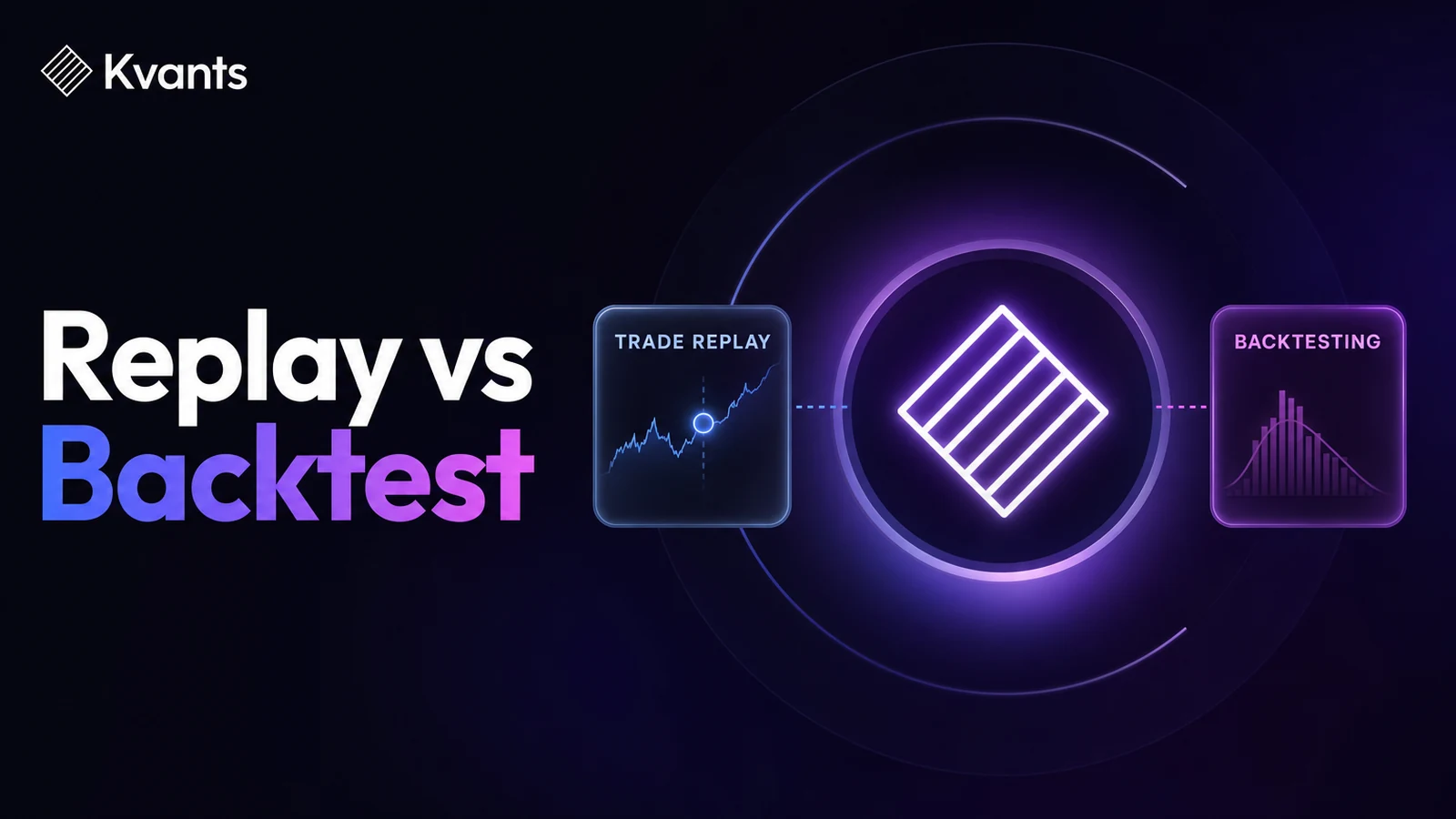
Compare trade replay vs backtesting, understand what each method can and cannot prove, and use a staged workflow to test strategy rules and execution separately.
Quick Answer
Trade replay rebuilds a past market session so you can review decisions or practice responding as prices unfold. Backtesting applies defined rules across historical data to estimate how a strategy would have behaved over many opportunities.
Use replay to examine recognition, timing, order placement, and decision-making. Use backtesting to evaluate expectancy, drawdowns, sensitivity, and performance across different periods. Neither proves future profitability: replay usually provides too few observations for broad conclusions, while a backtest can mislead when its rules, data, costs, or assumptions are unrealistic.
Key Takeaways
- Replay is primarily a decision and execution tool; backtesting is primarily a strategy evaluation tool.
- A replay session can reveal hesitation or poor order handling, but a handful of sessions cannot establish a durable edge.
- A backtest can process many historical opportunities, but only after the setup has been translated into explicit rules.
- Blind market replay is more useful than reviewing a completed chart because it reduces knowledge of what happens next.
- The strongest workflow is usually rule definition, backtesting, replay practice, paper trading, and controlled deployment.
- Keep strategy validity and execution quality separate so one does not hide problems in the other.
What Trade Replay and Backtesting Actually Measure
The methods answer different questions.
Trade replay presents historical market action progressively rather than showing the completed outcome immediately. Depending on the tool and workflow, replay may involve reviewing your recorded executions or practicing a setup on a historical session you have not studied.
When reviewing an actual trade, replay can help you ask:
- What information was available when I entered?
- Did I follow the planned trigger?
- Was the stop placed where the setup became invalid?
- Did an earlier win or loss affect the next decision?
- Was the exit planned, reactive, or accidental?
Blind replay adds a practice element. You can pause before the next bar, record a decision, and then reveal what happened. This does not perfectly reproduce live pressure, fills, or uncertainty, but it is more realistic than explaining a completed chart with the full outcome visible.
Backtesting applies a strategy's rules to historical market data. Its purpose is to evaluate the behavior of those rules over a larger sample. Relevant outputs may include trade count, average result, expectancy, maximum drawdown, exposure, losing streaks, and sensitivity to assumptions.
Backtesting asks questions such as:
- Did the rules produce a positive historical expectancy after modeled costs?
- How variable were the results across market conditions?
- How severe and prolonged were historical drawdowns?
- Does the result depend on one parameter value or a small number of trades?
- Does the strategy remain credible in unseen or stressed periods?
Replay evaluates how a trader interacts with a setup. Backtesting evaluates what happened when consistent rules were applied repeatedly.
A backtest's equity curve and trade-by-trade log.
Trade Replay vs Backtesting Comparison
| Method | Best For | Main Limitation |
|---|---|---|
| Actual-trade replay | Reviewing entries, exits, sequencing, hesitation, and rule adherence | It examines decisions already made and is vulnerable to hindsight during review |
| Blind market replay | Practicing setup recognition and discretionary decisions without seeing the full outcome | The sample is usually small, and simulated pressure differs from live trading |
| Rule-based backtesting | Evaluating repeated strategy behavior, drawdowns, costs, and robustness | Results depend on data quality, rule precision, and realistic execution assumptions |
| Manual historical review | Developing an initial hypothesis and finding examples worth formalizing | Selection bias and inconsistent interpretation make performance conclusions unreliable |
There is no universal winner. The right method depends on the uncertainty you are trying to reduce.
If you do not know whether the strategy's rules had a historical edge, replay alone is insufficient. If a credible backtest exists but you cannot recognize or execute the setup consistently, running more backtests may not solve the problem.
A Step-by-Step Validation Workflow
1. State the hypothesis before opening a chart
Describe the setup, market, timeframe, entry, exit, and risk logic in plain language. Include conditions that invalidate the trade.
For example: “Enter a long breakout only when price closes above the prior session high, relative volume meets a defined threshold, and the broader trend filter is positive. Place the stop below the breakout structure and exit at the stop, target, or session cutoff.”
This statement is not yet testable. Terms such as “breakout structure” and “broader trend” still require exact definitions.
2. Convert judgment into auditable rules
Define every variable using information available at the decision time. Specify:
- eligible instruments and sessions;
- indicator formulas and lookback periods;
- exact entry and exit triggers;
- order type and fill assumptions;
- position-sizing method;
- commissions, fees, spread, and slippage assumptions;
- handling of gaps, overlapping signals, and missing data.
If an important condition cannot be formalized because it depends on visual judgment, label it explicitly. Do not quietly substitute hindsight for a rule.
3. Backtest the strategy logic
Run the rules over enough relevant history to observe different conditions. Examine more than net profit. Review trade count, expectancy, drawdown, concentration of returns, holding time, and performance by period or market regime.
Then challenge the result. Change plausible parameters, increase cost assumptions, reserve out-of-sample data, and use walk-forward or stress analysis where appropriate. The objective is not to discover the most attractive configuration. It is to determine whether the idea survives reasonable changes.
4. Use blind replay to practice the remaining decisions
Recreate sessions without exposing future bars. Before advancing, record:
- whether the setup is valid;
- intended entry, stop, and target;
- planned risk;
- reasons to skip the trade;
- any discretionary adjustment.
Compare each action with the written plan. Score process separately from profit or loss. A compliant loss is not automatically an execution mistake, and a profitable rule violation is not evidence of good execution.
5. Review full-session behavior
An isolated trade does not show how decisions interact. Replay an entire session when investigating overtrading, revenge trading, changing size, or abandoning rules after an early result.
Note what happened before each deviation. Useful context includes trade number, prior session result, time of day, setup quality, and whether a daily risk limit was approaching.
6. Move to controlled forward observation
Replay and backtesting both use known historical data. Paper trading introduces future observations, platform interaction, signal timing, and an operational routine. It can expose issues such as missed alerts or ambiguous rules, although simulated fills may differ from live execution.
If the process progresses to live trading, use controlled risk and predefined limits. Historical evidence and competent rehearsal reduce uncertainty; they do not remove it.
Configuring a backtest in Kvants Studio.
Worked Example: Diagnosing a Breakout Strategy
Suppose a trader has taken 12 long breakouts. Seven lost money, and several entries occurred shortly before price reversed. The trader suspects poor timing.
Replay could uncover three execution patterns:
- Two entries occurred before the required candle closed.
- Three valid signals were entered late after price had moved far from the planned level.
- Seven entries followed the written trigger correctly.
That review identifies execution issues, but it still does not show whether the underlying breakout rule is viable.
The trader then formalizes the trigger, trend filter, stop, target, session window, and costs. A backtest may show that the strategy behaved differently depending on volatility or that its result was highly sensitive to the entry threshold. Alternatively, it may show stable historical behavior while the trader's actual results were damaged by early and late entries.
Each finding requires a different response:
- Weak backtest and weak execution: revise or reject the strategy before more practice.
- Credible backtest and weak execution: simplify the rules and use replay to rehearse recognition and timing.
- Weak backtest and disciplined execution: do not blame psychology for a strategy problem.
- Credible backtest and disciplined execution: continue validation with unseen data and controlled forward observation.
The key is diagnosis. Replay explains how decisions departed from the plan; backtesting evaluates the plan itself.
Backtest results with metric tiles and gate coaching.
Common Failure Modes
Treating a few replay wins as proof
A successful replay sequence can reflect a favorable period, remembered charts, or chance. Record every eligible setup rather than selecting memorable sessions, and avoid making statistical claims from a small practice sample.
Replaying with the outcome visible
If you already know where the session ends, your interpretation may become unusually precise. Hide future bars, start before the setup, and commit decisions before advancing.
Backtesting vague visual rules
Rules such as “strong momentum” or “clean support” can change from chart to chart. Define measurable proxies or retain the condition as a separately scored discretionary element.
Ignoring execution assumptions
A backtest that fills every order at the desired price may exaggerate what was achievable. Model costs and order behavior consistently, especially around gaps, thin liquidity, and fast moves.
Optimizing until the history looks ideal
Repeatedly adjusting filters to improve the same dataset can fit noise. Reserve unseen data and prefer logic that remains credible across nearby parameter values.
Mixing strategy and trader errors
A losing trade can follow every rule. A winning trade can violate several. Label strategy outcome, rule adherence, and execution quality separately before deciding what needs to change.
Using Kvants for the Backtesting Stage
Replay observations often begin as plain-English ideas: “This setup works better after consolidation,” or “late entries appear to damage the payoff.” Before testing those claims, they must become explicit conditions.
Kvants Studio turns plain-English trading ideas into editable, auditable strategy logic for stocks and crypto research. Traders can use its NautilusTrader-based event-driven backtesting, parameter sweeps, walk-forward analysis, and crisis-stress validation to investigate the rule-based part of a hypothesis.
That does not replace replay. Conditions involving hesitation, attention, or discretionary chart reading still require a review or practice process. A useful division of labor is to use replay to generate and diagnose execution hypotheses, then use backtesting to test the portions that can be expressed as consistent rules.
The Kvants documentation explains the strategy and testing workflow. Keep assumptions visible, inspect the generated logic, and treat every result as research evidence rather than a forecast.
Frequently Asked Questions
Is trade replay the same as paper trading?
No. Replay runs through a historical session, often at a selectable speed. Paper trading observes new market activity as it occurs but uses simulated orders. Replay is efficient for repetition; paper trading better tests real-time routines and signal handling.
Can trade replay prove that a strategy works?
Not by itself. Replay can provide examples and reveal execution patterns, but selected sessions or small samples are not sufficient evidence of a durable edge. Formal backtesting and forward observation address different parts of that question.
Should discretionary traders backtest?
Yes, where their rules can be defined consistently. Fully discretionary judgment may not be completely testable, but objective components such as market filters, time windows, stop distances, and exits can often be evaluated separately.
Should I backtest or replay first?
Start by defining the hypothesis. Backtest its objective rules before investing heavily in execution practice. If the setup includes unresolved visual judgment, use replay early to clarify that judgment, then formalize whatever can be measured.
How do I know whether execution or the strategy is failing?
Compare planned trades with actual trades. If compliant executions perform poorly across a meaningful sample, investigate the strategy. If the tested rules remain credible but actual trades repeatedly violate entries, stops, sizing, or session limits, focus on execution.
Risk Note
This article is educational and is not investment advice. Trading involves risk, including the possible loss of capital. Historical replay, simulated execution, and backtested performance do not guarantee future results. Data quality, costs, liquidity, model assumptions, and changing market conditions can materially affect outcomes. Kvants is a research tool, not an investment adviser.