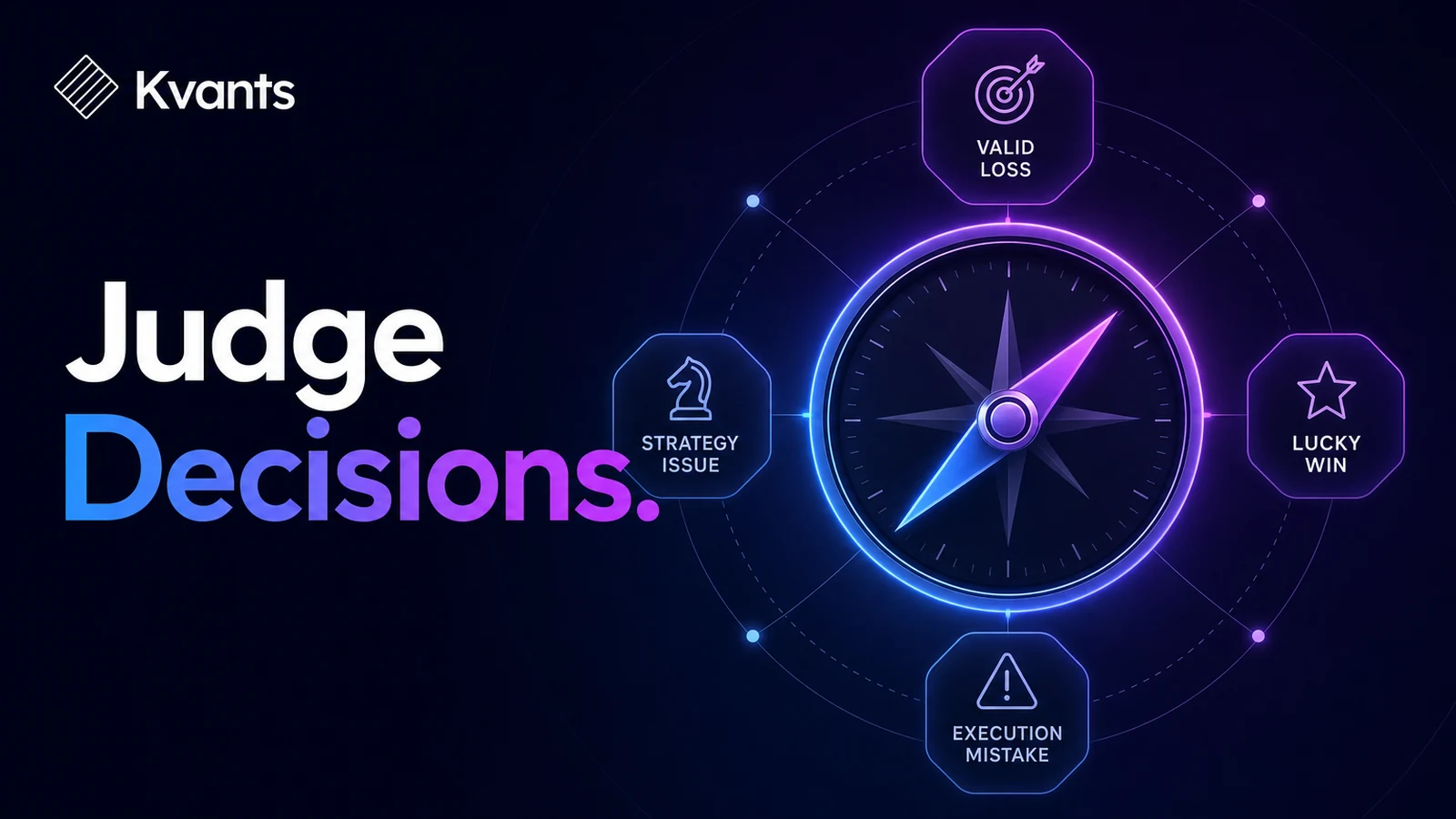
Learn how to assess trade quality with an outcome-independent scorecard that separates valid losses, lucky wins, execution mistakes, and strategy issues.
Quick Answer
A trade quality assessment measures whether a trade followed a valid, predefined process—not whether it made money. Review setup validity, risk, entry execution, position management, and market context against rules written before the outcome was known. This lets you recognize both good losses and bad wins.
The main limitation is that process quality cannot prove a strategy has an edge. A perfectly executed strategy can still be unprofitable. Use trade-quality scoring to evaluate execution, then use an adequate sample and structured testing to evaluate the strategy itself.
Key Takeaways
- A winning trade can be low quality if it broke the plan, while a losing trade can be high quality if it followed valid rules.
- Score decisions against criteria defined before reviewing the result.
- Keep execution quality separate from strategy performance; they answer different questions.
- Review patterns across groups of trades rather than reacting to one outcome.
- Convert repeated observations into explicit rules, then test those rules before changing your process.
- Include costs, fill quality, and position size when assessing real execution.
What Trade Quality Actually Measures
Trade quality is the degree to which a trade matched a predefined decision process. It asks: given the information available at the time, did the trader take an allowed setup, control risk, execute correctly, and manage the position according to plan?
That is different from trade outcome. Outcome measures what happened after the decision, usually as profit, loss, or an R-multiple. Quality measures how the decision was made.
Keeping those concepts separate produces four useful classifications:
| Classification | Process | Outcome | Interpretation |
|---|---|---|---|
| Good win | Followed | Profitable | Valid execution with a favorable outcome |
| Good loss | Followed | Unprofitable | Valid execution with an unfavorable outcome |
| Bad win | Violated | Profitable | Poor process temporarily rewarded |
| Bad loss | Violated | Unprofitable | Poor process and an unfavorable outcome |
Bad wins deserve special attention because they reinforce behavior that may be harmful over a larger sample. Examples include chasing an entry, exceeding the planned size, removing a stop, or taking an unqualified setup that happens to work.
A good loss should not automatically trigger a strategy change. If the setup was valid and execution matched the plan, the loss may simply be part of the strategy's normal outcome distribution.
Build a Trade Quality Assessment Scorecard
A scorecard should be short enough to complete consistently and specific enough to prevent hindsight from controlling the grade. The following eight-point model is a starting framework, not a universal standard.
1. Setup validity: 0–2 points
Award two points if every required entry condition was present. Award one if the setup was valid but the record is incomplete or an optional preference was missing. Award zero if a required condition was absent.
The conditions must be observable. “The chart looked strong” is difficult to audit. “Price closed above the prior 20-bar high while volume exceeded its defined threshold” is testable.
2. Risk definition: 0–2 points
Award full points when the stop, invalidation condition, position size, and maximum planned loss were established before entry. Deduct points for unclear risk or sizing errors. Assign zero when the trade had no defined invalidation or exceeded a hard exposure limit.
The stop should represent where the trade thesis becomes invalid, while position size should translate that distance into acceptable account risk.
3. Entry execution: 0–2 points
Compare the actual entry with the permitted entry method. Check whether the trader waited for confirmation, used an allowed order type, avoided prohibited chasing, and entered within the planned price range.
A valid signal with an impulsive entry can still be a low-quality trade. Poor entry execution may materially change both risk and reward.
4. Position management: 0–1 point
Award the point when exits, stop adjustments, scaling decisions, and time limits followed the plan. Deduct it for unplanned interference, such as widening a stop or taking an early exit solely because of discomfort.
Discretion is not automatically a violation. It is valid when the plan clearly defines when and how discretion may be used.
5. Context and operational compliance: 0–1 point
Confirm that the trade was allowed under the strategy's session, market, volatility, event, liquidity, and account constraints. Also check practical requirements such as total open risk and daily loss limits.
An otherwise valid setup may be prohibited if it appears outside the tested trading window or while portfolio exposure is already at its limit.
Kvants audits that the engine runs the strategy you configured.
A Step-by-Step Trade Review Workflow
Step 1: Freeze the rules before looking at P&L
Write the scorecard from the trading plan, not from the most recent trades. If the rules are created after seeing an outcome, the review will tend to justify what happened.
Where possible, hide the P&L column during the first pass. Review the chart, entry conditions, planned risk, orders, and management decisions first.
Step 2: Reconstruct the information available at entry
Use the chart and notes as they appeared when the decision was made. Do not grade the entry using later candles, subsequent news, or the eventual high and low.
Ask whether the decision was reasonable under the original rules—not whether a better decision is obvious in hindsight.
Step 3: Score each category and record evidence
Do not enter only a number. Add a short reason, such as:
- “All breakout conditions present; entered two ticks above permitted range.”
- “Setup valid, but total open risk exceeded the portfolio limit.”
- “Stop and target followed exactly; full planned loss taken.”
Evidence makes the score auditable and helps reveal recurring failure modes.
Step 4: Record the outcome separately
After grading quality, add net P&L and realized R. A simple realized R calculation is:
Realized R = net trade result / initial planned risk
If the initial planned risk was $100 and the net result after relevant costs was a $75 loss, the result was -0.75R. R normalizes outcomes across trades with different position sizes, but it does not replace the process score.
Step 5: Group trades into diagnostic buckets
Separate high-quality trades from rule violations, then evaluate their results independently.
- High-quality trades performing as expected suggest the process and strategy may be aligned.
- High-quality trades performing poorly may justify deeper strategy analysis—but not an immediate conclusion from a small sample.
- Low-quality trades performing poorly indicate an execution problem.
- Low-quality trades performing well indicate dangerous positive reinforcement.
Step 6: Change one layer at a time
If execution is the issue, simplify the checklist, reduce decision pressure, or add a procedural control. If compliant trades are underperforming, investigate the strategy assumptions, market regime, costs, and implementation.
Avoid changing entry rules to solve a discipline problem or adding behavioral controls to rescue a strategy with weak evidence.
The Kvants trading terminal and market co-pilot.
Worked Example: Three Trades, Three Different Lessons
Assume a trader uses the eight-point scorecard and treats seven or eight points as high quality. That threshold is illustrative and should be defined in advance.
Trade A: -1R and 8/8 quality
The setup met every condition, size matched the risk plan, and the stop was executed without interference. Price reached the invalidation level.
This is a good loss. The correct response is to log it and continue reviewing the strategy over an appropriate sample—not to move the stop on the next trade.
Trade B: +1.4R and 3/8 quality
The trader entered late after missing the planned trigger, doubled normal size, and had no initial stop. The market reversed in the trader's favor before the position was closed profitably.
This is a bad win. The positive outcome does not validate the decision. The useful action is to address the chase and sizing violations.
Trade C: -0.6R and 5/8 quality
The setup and risk were valid, but the trader exited early after normal adverse movement. Price later reached the planned target.
This is primarily an execution issue. The review should focus on the early-exit rule, not on redesigning the entry signal based on what happened afterward.
The point is not that every score gives an automatic diagnosis. The score directs the next investigation and prevents P&L from being the only evidence considered.
Common Failure Modes
Scoring with hindsight
A trader gives more points to winners because the setup now appears “obviously” strong. Prevent this by using binary, observable criteria and grading before viewing the outcome.
Using vague standards
Terms such as clean, strong, weak, or enough confirmation allow the definition to shift from trade to trade. Replace them with thresholds, time windows, named conditions, and explicit exceptions.
Treating compliance as proof of an edge
Perfect rule adherence only proves that the rules were followed. It does not prove positive expectancy. Strategy validity requires separate research that accounts for sample size, costs, market conditions, and out-of-sample behavior.
Changing the rubric repeatedly
If scoring criteria change every week, scores cannot be compared reliably. Version the rubric and record the date of each change. Re-score historical trades when practical or analyze each version separately.
Tracking too many fields
A complex scorecard often becomes an abandoned scorecard. Start with the decisions most closely connected to the strategy's hypothesis and risk controls. Add fields only when they support a specific review question.
Ignoring implementation costs
A theoretically valid entry may be poor in practice if spreads, fees, slippage, or market impact remove its expected advantage. Process quality should include whether the trade was executed under realistic conditions.
Turn Review Findings Into Testable Rules
A trade review often identifies a plausible change: avoid a certain session, require a volatility filter, use a time-based exit, or reject entries that are too far from the trigger. That observation is a hypothesis, not yet an improvement.
First, define the proposed rule precisely. Then compare the original strategy with the modified version while keeping other variables stable. Examine more than total return: trade count, drawdown, outcome distribution, costs, and sensitivity to small parameter changes also matter.
Kvants Studio can turn a plain-English trading idea into editable, auditable strategy logic. Traders can use its event-driven backtesting, parameter sweeps, walk-forward analysis, and crisis-stress validation to investigate objective rules found during review. The backtests run on NautilusTrader's event-driven engine.
For example, “avoid late entries” must become something measurable, such as a maximum distance from the signal price or a maximum number of bars after the trigger. That rule can then be tested against the baseline rather than accepted because of a few memorable trades.
The controlled sequence is:
- Identify a repeated pattern in reviewed trades.
- Express it as an objective rule.
- State what improvement the rule is expected to produce.
- Test the baseline and revised versions under comparable assumptions.
- Validate outside the data used to form the idea.
- Move to a controlled paper workflow before considering live use.
Additional implementation guidance is available in the Kvants documentation. Kvants is a research environment; it does not determine whether a strategy is suitable for a particular trader or guarantee that a proposed change will work.
A strategy laid out end to end in the Kvants editor.
Frequently Asked Questions
Can a losing trade be a good trade?
Yes. A losing trade can be high quality when it met the setup criteria, used correct size, respected risk limits, and followed the planned exit process. The loss is still economically real, but it does not necessarily indicate a decision error.
Can a profitable trade be a bad trade?
Yes. A trade that violated setup, sizing, stop, or exposure rules can be low quality even when profitable. Classifying it as a bad win prevents a favorable outcome from validating an unsafe process.
What is a good trade-quality score?
There is no universal score. The threshold depends on the rubric and the importance of each rule. Hard risk violations may automatically make a trade noncompliant regardless of its total points. Define the threshold and any automatic failures before reviewing results.
How often should I review trade quality?
Score trades soon after the session while the decision context is still available, then review aggregated patterns weekly or after a defined batch of trades. Strategic changes should generally require more evidence than a single daily or weekly result.
Should discretionary traders use a scorecard?
Yes, provided their discretion is bounded. A discretionary plan can define acceptable setup families, contextual requirements, invalidation rules, and risk limits. If every decision is justified only after the fact, consistent assessment and testing become difficult.
Does high trade quality mean the strategy is profitable?
No. High quality means the trader followed the specified process. The strategy may still have weak expectancy, excessive costs, unstable parameters, or poor compatibility with current conditions. Execution assessment and strategy validation must remain separate.
Risk Note
This article is educational and is not investment advice. Trading involves risk, and even a well-executed process can produce losses. Backtested performance does not guarantee future results. Evaluate strategy assumptions, costs, liquidity, and personal risk constraints before paper or live trading.