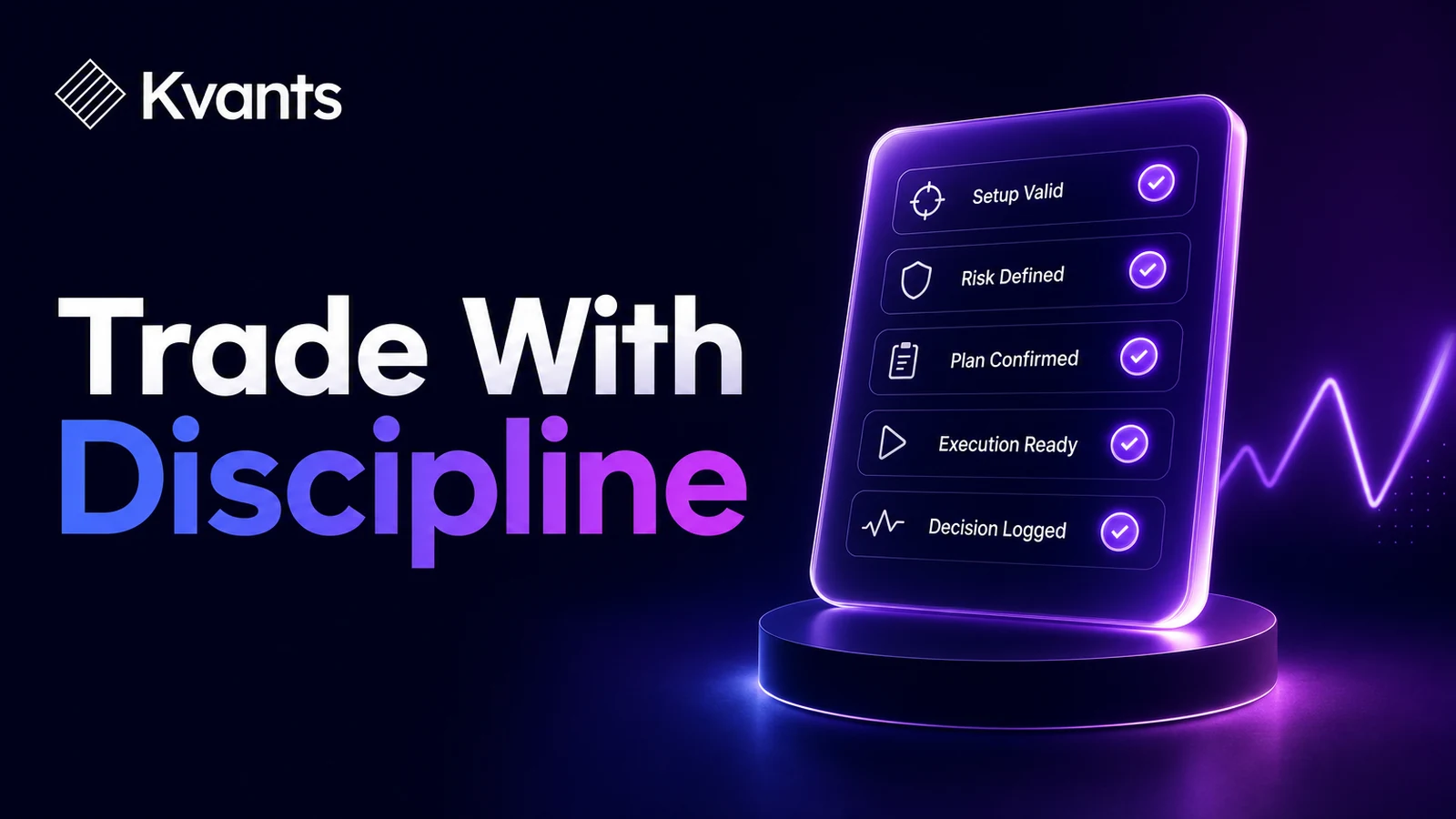
Build a practical pre-trade checklist that filters invalid setups, controls risk, records decisions in real time, and separates strategy problems from execution errors.
Quick Answer
A useful pre-trade checklist confirms four things before an order is placed: the setup is valid, current market conditions permit the trade, risk is defined, and the trader is ready to execute the plan. Keep it short enough to complete in under a minute and make each item answerable with yes, no, or a specific value. A checklist can improve consistency, but it cannot turn a weak strategy into a strong one. Its main purpose is to prevent avoidable execution errors and preserve evidence about how valid setups actually perform.
Key Takeaways
- Separate setup, context, risk, execution, and personal-readiness checks.
- Write binary rules wherever possible; vague prompts invite hindsight.
- Complete the checklist before entry, not after seeing the result.
- Treat any failed mandatory item as a reason to skip the trade.
- Record checklist compliance separately from profit and loss.
- Review whether each item filters harmful trades or merely adds friction.
What a Pre-Trade Checklist Should Accomplish
A pre-trade checklist is a decision gate between noticing an opportunity and placing an order. It should answer a narrow question: Does this trade qualify under the plan right now?
That is different from a watchlist, which identifies instruments worth monitoring. It is also different from a trading journal, which records decisions and outcomes for later review.
The checklist has three practical jobs:
- Reject invalid trades. A setup that is close to the rules is not necessarily a valid setup.
- Define the risk before exposure begins. Entry, invalidation, size, and planned exits should not be improvised after the position moves.
- Create an honest record. Recording the decision before the outcome prevents a trader from unconsciously rewriting the original reasoning.
A good checklist does not need to predict whether the next trade will win. Valid trades can lose, while invalid trades can make money. The objective is consistent exposure to the process you intended to evaluate.
The Five-Part Pre-Trade Checklist Framework
1. Setup validity
Start with the conditions that define the trading opportunity. These should distinguish the setup from something that merely looks similar.
For a breakout strategy, setup questions might include:
- Has price closed above the defined resistance level?
- Was the consolidation at least the required number of bars?
- Is current volume above the strategy’s threshold?
- Has the setup already triggered once?
Avoid items such as “Does the chart look strong?” unless “strong” has an objective definition. If two careful traders could answer differently while looking at the same data, the rule needs clarification.
2. Market context
A technically valid pattern may occur in conditions excluded by the plan. Context checks identify those exclusions without changing the setup after every loss.
Possible checks include:
- Is the instrument liquid enough for the intended order size?
- Is the trade inside the approved session?
- Is a scheduled event excluded by the plan approaching?
- Does the strategy permit trading in the current trend or volatility regime?
- Is the broader market filter satisfied?
Only include context conditions that are part of the strategy or are being tested as explicit hypotheses. Adding filters because the last few trades failed can produce an overfitted decision process.
3. Risk definition
The risk section must be completed before entry. At minimum, record:
- Intended entry price or entry condition
- Invalidation level
- Planned position size
- Initial risk in currency, percentage, or R
- Profit-taking or exit condition
- Remaining daily or account risk capacity
Position size should follow from the distance between entry and invalidation—not from confidence, frustration, or the desire to recover a previous loss.
If there is no defensible invalidation point, there is no defined trade risk. “I will exit if it feels wrong” is not a usable risk rule.
4. Execution plan
A strategy can be valid while the intended order is unsuitable. Confirm how the trade will be entered and managed:
- Is the order type specified?
- Is the entry still valid at the current price?
- Does estimated slippage or spread make the trade impractical?
- Are partial exits, trailing rules, or time exits defined?
- What happens if the market gaps through the intended level?
This step is especially important when a setup is discovered late. Chasing price changes the entry, stop distance, payoff profile, and sometimes the entire strategy.
5. Trader readiness
Some execution risks are behavioral rather than technical. Keep this section concrete:
- Am I inside my approved trading hours?
- Have I reached a daily loss or trade-count limit?
- Am I increasing size outside the plan?
- Am I entering mainly to recover a previous loss?
- Can I monitor the trade as required by the strategy?
This section is not a demand to feel perfectly calm. Its purpose is to identify conditions under which the trader has already decided not to participate.
The Kvants trading terminal and market co-pilot.
A Worked Trade Entry Checklist
Consider a hypothetical long breakout strategy. Its plan requires a 20-bar high breakout, above-average volume, a stop below the consolidation, and a minimum planned reward-to-risk ratio of 2:1.
Before entry, the trader records:
| Category | Check | Result |
|---|---|---|
| Setup | Price closed above the previous 20-bar high | Yes |
| Setup | Breakout volume exceeded the defined average | Yes |
| Context | Entry is within the approved session | Yes |
| Context | No excluded event window applies | Yes |
| Risk | Entry and invalidation are recorded | Yes |
| Risk | Position size remains within the risk limit | Yes |
| Risk | Planned reward-to-risk is at least 2:1 | No |
| Execution | Current price remains inside the allowed entry range | No |
| Readiness | Daily loss and trade-count limits remain available | Yes |
The setup itself is valid, but the trade fails two mandatory checks. Price has moved too far beyond the breakout, reducing the available reward relative to the stop distance. The correct checklist decision is no trade.
Suppose price continues higher afterward. That does not make the decision wrong. The checklist evaluates whether the planned trade was available, not whether price eventually moved in the anticipated direction.
How to Build Your Checklist Step by Step
Step 1: Start with the written strategy
Extract the conditions that define entry, invalidation, sizing, and exit. Do not begin with a generic checklist downloaded from another trader; its rules may not match your market, timeframe, or execution method.
Step 2: Classify each item
Place every condition under setup, context, risk, execution, or readiness. Classification exposes duplication and helps distinguish strategy rules from personal controls.
Step 3: Define mandatory and informational items
A mandatory item blocks the trade when it fails. An informational item records context for later analysis but does not prevent entry.
For example, “risk is within the account limit” should usually be mandatory. “Market opened with a gap” might be informational while its relevance is still being studied.
Step 4: Replace vague language
Rewrite “good volume” as a specified comparison, such as volume relative to a defined lookback. Rewrite “not overextended” as a maximum entry distance from the trigger or invalidation level.
Not every discretionary observation can be quantified. When judgment remains necessary, define the evidence required and record a brief explanation before entry.
Step 5: Test the workflow without capital at risk
Use historical review or paper trading to confirm that the checklist can be completed with information available at the decision time. Check that rules do not depend on a candle’s final values before that candle has closed.
Step 6: Review checklist usefulness
After a meaningful sample, compare four groups:
- Valid trades executed according to plan
- Valid trades executed with errors
- Invalid trades that were taken anyway
- Trades correctly skipped because a mandatory check failed
Do not judge a filter from one skipped winner or one avoided loser. Ask whether it changes the distribution of results and whether the rule has a defensible market or risk rationale.
Configuring a backtest in Kvants Studio.
Common Checklist Failure Modes
Too many items
A checklist with dozens of repeated prompts will eventually be rushed or ignored. Combine overlapping items and retain only decisions that can change whether or how the trade is taken.
Completing it after entry
Post-entry completion turns the checklist into an explanation exercise. Record the answers before placing the order and preserve the timestamp where possible.
Treating every condition as optional
If “no” never changes the decision, the checklist is not a decision gate. Clearly mark the conditions that invalidate a trade.
Confusing a winning trade with a compliant trade
An off-plan winner is still an execution error. Rewarding it encourages inconsistent behavior and contaminates evidence about the planned strategy.
Adding rules after isolated losses
Every extra filter reduces the number of eligible trades and may fit historical noise. Treat proposed filters as hypotheses to test rather than immediate repairs.
Ignoring execution costs
A setup can look attractive before spreads, fees, slippage, and order behavior are considered. These costs can be particularly important for frequent strategies or less liquid instruments.
Turning Checklist Rules Into Testable Logic
Once the checklist is stable, separate machine-testable market rules from human controls.
Setup definitions, session filters, indicator thresholds, entries, stops, and exits can often be expressed as objective logic. Fatigue, emotional state, or the ability to supervise a position generally cannot be inferred reliably from price data and should remain human checks.
With Kvants Studio, traders can turn plain-English market rules into editable, auditable strategy logic. They can then run event-driven backtests, explore parameters, and use walk-forward or crisis-stress validation to examine whether the objective checklist rules remain credible outside one historical sample.
This does not validate subjective readiness or guarantee that the checklist will work in future markets. It helps test the portion that can be defined from available data. The Kvants documentation provides more detail on prompting, inspecting strategy logic, and exporting Pine Script v6 for further verification.
Exporting a Kvants strategy to TradingView Pine v6.
Frequently Asked Questions
How long should a pre-trade checklist be?
It should be as short as possible without omitting a decision that can invalidate the trade. For many strategies, roughly five to twelve checks is workable, but complexity depends on the strategy. Completion time and error rates matter more than a universal item count.
Should every checklist item be yes or no?
Mandatory decision items should usually be binary or numeric. Context notes can remain descriptive when they are being collected for research. If a subjective item blocks trades, define what evidence qualifies as a yes.
Does a checklist improve trading performance?
It may reduce unplanned entries, sizing mistakes, late chasing, and other execution errors. It cannot guarantee better returns, and it will not repair a strategy with negative expectancy. Measure compliance and strategy results separately.
What should happen when one item fails?
If the item is mandatory, skip the trade or wait until the condition becomes valid. Do not override it because the setup feels unusually convincing. If overrides are allowed, define those exceptions in advance and record them separately.
Should skipped trades be reviewed?
Yes, but avoid scoring the decision solely by what price did afterward. Review whether the checklist was applied correctly and whether the failed condition remains useful across a sufficient sample of opportunities.
Can discretionary traders use testable checklists?
Yes. Objective elements can be measured, while discretionary elements can be recorded with predefined evidence and brief notes. The goal is not to eliminate judgment; it is to make that judgment visible and reviewable.
Risk Note
This article is educational and is not investment advice. Trading involves risk, including the possible loss of capital. A checklist can support consistent decisions but cannot remove market, liquidity, execution, or behavioral risk. Backtested performance does not guarantee future results. Kvants Studio is a research tool, not an investment adviser, and its outputs should be independently reviewed before paper or live use.