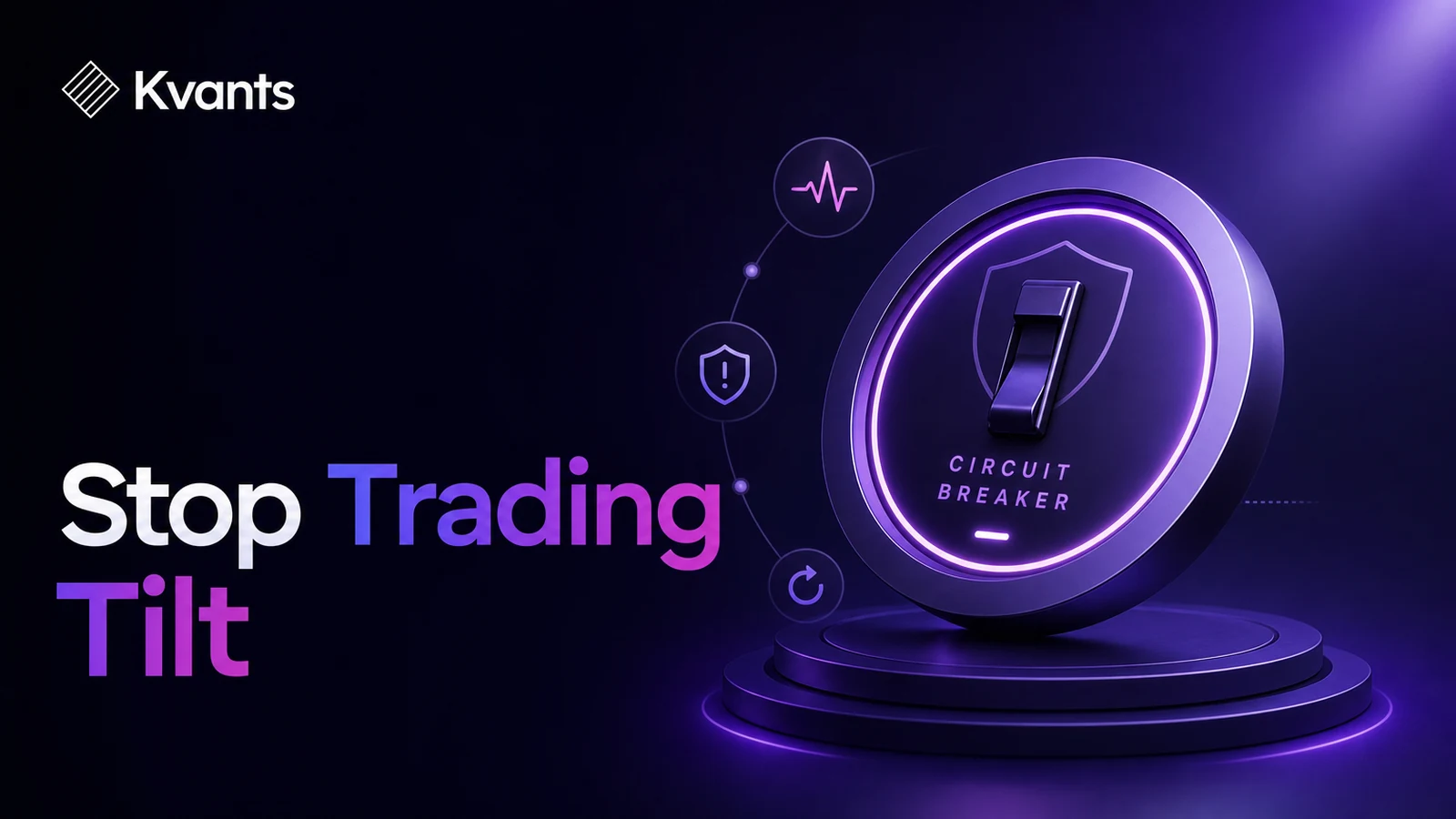
Learn how to detect trading tilt through observable rule deviations, activate objective circuit breakers, and return through a controlled reset process.
Quick Answer
To stop trading tilt, define its observable warning signs before the session and connect each one to a mandatory action. Warning signs might include increasing size after a loss, exceeding your trade limit, entering without confirmation, or widening a stop. When a trigger occurs, pause new orders, manage existing risk according to the written plan, record the deviation, and follow objective criteria for returning.
The main limitation is enforcement. A circuit breaker only works when its triggers are specific and its response is decided in advance. “Stop when frustrated” is too subjective to protect an account consistently.
Key Takeaways
- Define tilt through observable actions rather than emotions alone.
- Monitor leading indicators such as unplanned size, invalid entries, altered stops, and accelerating trade frequency.
- Match every trigger to a predetermined response: pause, reduce risk, or end the session.
- Keep the immediate shutdown procedure separate from the later decision to resume trading.
- Judge execution independently from outcomes; a valid loss is not a discipline failure.
- Test objective controls against historical trade sequences so they do not obstruct normal strategy behavior.
What Trading Tilt Looks Like in Practice
Trading tilt is a temporary deterioration in decision quality that causes a trader to abandon, reinterpret, or selectively apply established rules. It may follow a loss, missed opportunity, technical mistake, unusually large win, or extended period without a setup.
Emotions such as frustration, fear, and excitement matter, but they are difficult to measure consistently. Their effects are easier to identify:
- Risk per trade rises without a planned reason.
- Trade frequency increases after a loss.
- An entry is taken before all conditions are present.
- A stop is removed or moved farther away.
- A winning position is closed early solely to repair session P&L.
- An unapproved market, setup, or timeframe is traded.
- A daily stop or trade cap is treated as optional.
One isolated error does not always indicate tilt. The more important warning is escalation. A missed entry leads to a late chase; the chase loses; size increases on the next trade; and the next setup is accepted without confirmation.
A circuit breaker is designed to interrupt that sequence. It is not intended to predict whether the next trade will win or lose.
Detect Tilt Before the Loss Limit
A monetary loss limit is essential, but it is a late indicator. Several avoidable decisions may occur before the account reaches it. Earlier detection can be organized into three layers.
Exposure signals
These indicate that risk is expanding unexpectedly:
- Actual risk exceeds planned risk.
- Total open risk breaches the portfolio limit.
- Position size increases immediately after a loss.
- Correlated positions create more exposure than the plan permits.
Execution signals
These indicate that the process has changed:
- Entry conditions are incomplete.
- An order is placed outside approved hours.
- A stop is widened or removed.
- The daily trade count is exceeded.
- A prohibited setup or instrument is traded.
Escalation signals
These identify a developing chain of deviations:
- Two rule violations occur in one session.
- A new position is opened immediately after a stopped trade.
- Order frequency rises as session P&L declines.
- Multiple trades require improvised exceptions to the written plan.
Thresholds must fit the strategy. A scalper and a swing trader should not share the same trade-count trigger. The goal is to detect separation between planned and actual behavior, not to impose arbitrary restrictions.
A strategy laid out end to end in the Kvants editor.
How to Stop Trading Tilt Step by Step
Step 1: Establish the normal operating rules
A circuit breaker needs a baseline. Write down the approved setups, entry window, maximum risk per trade, maximum total exposure, daily trade cap, stop policy, and session loss limit.
Use measurable language. “Trade smaller after a difficult start” is ambiguous. “Risk no more than 0.25% of starting session equity after two consecutive losses” is auditable.
You can also express risk in R, where 1R is the planned loss between entry and initial stop. If that planned loss is $100, then 1R equals $100 for the trade. This makes deviations easier to compare when position sizes change.
Step 2: Find the earliest recurring deviation
Review previous sessions and locate the first observable action that tended to precede escalation. It might be entering too quickly after a loss, changing markets, abandoning a confirmation rule, or increasing size.
Do not begin with the worst outcome, such as reaching the daily loss limit. Start with the earliest behavior you could realistically interrupt.
Step 3: Create a trigger ladder
Use several response levels instead of relying on one catastrophic limit. For example:
- Level 1: One process deviation triggers a 15-minute pause and checklist review.
- Level 2: Two deviations in one session reduce permitted risk for the rest of the day.
- Level 3: Unapproved size, a hard-rule violation, or the session loss limit ends trading for the day.
These thresholds are examples, not universal recommendations. Select limits that account for the strategy’s trade frequency, normal loss sequences, and account restrictions.
Step 4: Define the shutdown procedure
State exactly what happens when a trigger activates. A practical procedure could require you to:
- Cancel unfilled discretionary orders.
- Manage open positions according to their original rules.
- Disable new order entry or log out of the platform.
- Record the trigger, time, setup, planned risk, and actual action.
- Avoid modifying the strategy during the same session.
Closing every open position immediately may itself be an untested deviation. Decide in advance whether existing positions remain under their original rules or must be closed because of account-level constraints.
Step 5: Set return-to-trading criteria
A pause is not a reset if trading resumes only because the urge to act remains strong. Require objective conditions such as a minimum waiting period, a completed review, confirmation that the next setup satisfies every rule, and a predefined risk level.
After a serious violation, the appropriate return point may be the next session rather than the next signal.
Step 6: Review process separately from outcome
Ask three questions after the session:
- Was the original trade valid under the plan?
- Was its result consistent with normal strategy uncertainty?
- Did the response to that result violate a rule?
A valid trade can lose. An invalid trade can win. Evaluating process separately prevents a favorable outcome from rewarding rule-breaking.
The AI assistant that builds and edits strategies.
Worked Example: Interrupting Escalation
Assume a plan permits three trades per session at 0.5R each. Two consecutive losses require a 20-minute pause. Any attempt to risk more than 0.5R ends the session.
The first trade follows the plan and loses 0.5R. The second is also valid and loses 0.5R. The losses alone do not prove that the trader is tilted or that the strategy has stopped working. They may represent ordinary variance.
The consecutive-loss trigger now activates. The trader cancels pending discretionary orders and begins the required pause. A market move occurs during the cooldown, but no entry is allowed.
After 20 minutes, a third setup appears and satisfies every condition. The plan permits one final trade at 0.5R. If the trader follows that rule, the circuit breaker has not prevented valid execution.
Suppose the trader instead attempts to risk 1R to recover the earlier losses. The session-ending rule activates before the order is placed. It does not claim the proposed trade would lose. It prevents an improvised recovery decision from replacing the established risk plan.
Failure Modes That Weaken Circuit Breakers
Using P&L as the only trigger
A trader can break several rules while remaining ahead for the day. A disciplined session can also reach its loss limit through valid trades. Track process deviations as well as money.
Allowing emotional exceptions
“Stop unless the next setup looks exceptional” creates room for reinterpretation. If exceptions are necessary, define their conditions before the session.
Ignoring normal strategy variance
A trigger set below the strategy’s ordinary loss frequency may prevent it from operating as tested. Examine historical losing sequences before selecting consecutive-loss or daily-trade thresholds.
Resuming without a protocol
A brief break does little if the trader returns with the same urgency, size, and recovery objective. Define what must be completed and what risk is allowed after the pause.
Changing several variables at once
Simultaneously reducing size, changing markets, adding filters, and modifying exits makes later analysis inconclusive. Apply the circuit breaker first, then evaluate strategy changes separately.
Turn Objective Controls Into Testable Rules
Emotions cannot be reproduced by an ordinary market backtest, but many risk controls can be expressed as objective logic. Examples include session windows, daily trade caps, position-size limits, cooldown periods, maximum open risk, and strategy exits.
Kvants Studio turns plain-English trading ideas into editable, auditable strategy logic. Its event-driven backtesting engine can help examine how objective controls affect trade sequences, while parameter sweeps, walk-forward analysis, and crisis-stress validation can test alternative settings across different periods. Revised logic can then move into a controlled paper workflow before live use.
That process does not prove that a discretionary trader will obey a circuit breaker. Kvants cannot identify frustration or replace broker-side account controls. Its role is to help test whether the objective parts of a strategy and risk plan behave as intended. The Kvants documentation explains the available research and validation workflows.
Kvants audits that the engine runs the strategy you configured.
Frequently Asked Questions
Can trading tilt happen after a winning trade?
Yes. A large win can lead to overconfidence, larger position sizes, weaker entry standards, or unnecessary additional trades. Monitor deviations whether session P&L is positive or negative.
Should I stop trading after every loss?
Not automatically. Losses can occur without any execution error. A stopping threshold should reflect the strategy’s historical sequences, trading frequency, account constraints, and your ability to execute the next signal correctly.
Is a daily loss limit enough to control tilt?
No. It limits monetary damage but may activate only after several poor decisions. Earlier triggers such as unplanned size, invalid entries, or accelerated order frequency can interrupt escalation sooner.
How long should a trading cooldown last?
There is no universal duration. It should be long enough to prevent immediate re-entry and complete the required review. Depending on the violation, that might mean several minutes, the rest of the session, or the next trading day.
Can I backtest trading psychology?
Not directly. Emotions are not present in standard market data. You can test objective controls associated with behavior, including trade caps, cooldown periods, sizing constraints, session limits, and exits. Journal data is still needed to evaluate discretionary deviations.
Risk Note
This article is educational and is not investment advice. Trading involves risk, and circuit breakers cannot eliminate losses or ensure rule compliance. Backtested performance does not guarantee future results. Validate all strategy, sizing, and loss-limit rules against your circumstances, market, platform, and account requirements before risking capital.