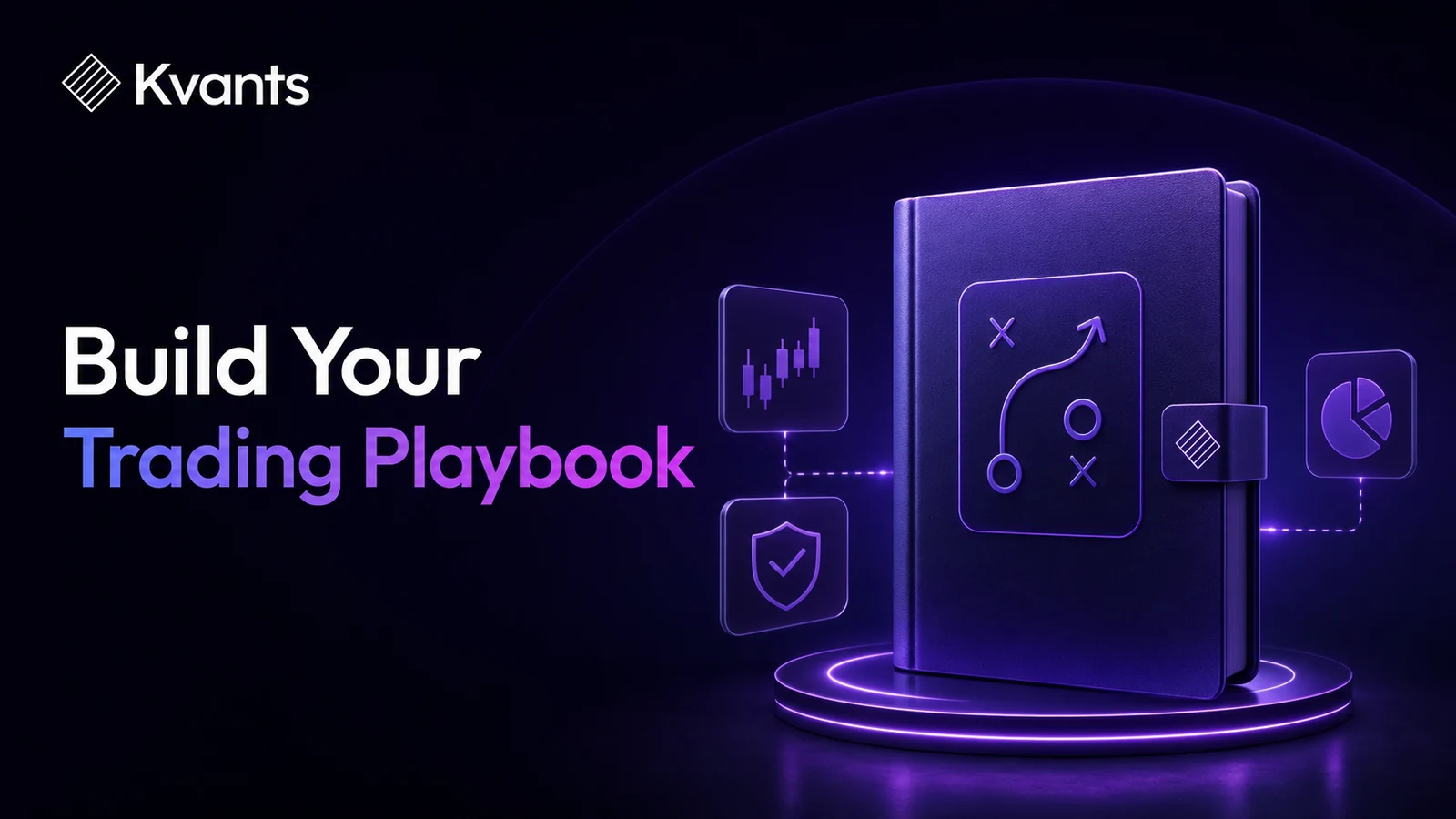
Learn how to build a trading playbook that defines your setups, risk, execution, and review process—and turns recurring observations into rules you can test.
Quick Answer
To build a trading playbook, document each setup as a complete decision process: when it is eligible, what triggers entry, where the idea becomes invalid, how size is calculated, how the position is managed, and what gets recorded afterward. Separate objective rules from discretionary judgment, then test the objective components before risking capital. The main limitation is that a playbook cannot eliminate uncertainty; it improves consistency and makes results easier to diagnose.
Key Takeaways
- A playbook is a catalog of defined setups, not a collection of chart screenshots or general trading reminders.
- Every setup needs eligibility, entry, invalidation, sizing, management, and exit criteria.
- Subjective concepts such as “strong momentum” should be translated into observable conditions where possible.
- Strategy quality and execution quality should be measured separately.
- Change one rule set at a time and preserve previous versions so results remain comparable.
- Backtesting can evaluate coded rules, but discretionary context may still require structured replay or paper trading.
What a Trading Playbook Should Contain
A trading plan sets broad boundaries: which markets you trade, when you trade, how much capital you risk, and when you stop for the day. A checklist helps you apply those boundaries before an individual order. A journal records what happened.
A trading playbook sits between them. It defines the specific setups you are permitted to trade and the decisions associated with each one.
Each playbook entry should answer seven questions:
- What is the setup? Give it a stable, descriptive name.
- When is it eligible? Define the market, timeframe, session, liquidity, trend, volatility, or event conditions.
- What triggers entry? Identify the observable event that authorizes an order.
- What invalidates the idea? State the price or condition that contradicts the original thesis.
- How is size determined? Connect position size to planned risk rather than conviction.
- How is the position managed? Define stops, targets, trailing logic, time exits, and scaling rules.
- How will it be reviewed? Specify the fields and tags needed to evaluate the setup later.
If a playbook entry cannot answer these questions, it is still an observation—not yet an executable setup.
How to Build a Trading Playbook Step by Step
1. Start with one recurring setup
Do not begin by documenting every pattern you have seen. Select one setup that appears repeatedly and can be described without referring to a specific historical chart.
Write the initial idea in plain English. For example: “Buy a pullback after an upside breakout when the broader trend is positive.” This is only a hypothesis. The remaining steps make it operational.
2. Define the setup’s boundaries
State where the setup applies and where it does not. Relevant boundaries may include:
- Market and instrument type
- Chart timeframe
- Trading session
- Minimum liquidity
- Trend or volatility regime
- Whether scheduled announcements are allowed
- Maximum acceptable spread or estimated execution cost
Boundaries prevent unrelated trades from being grouped under the same setup name. A five-minute equity breakout and a daily crypto breakout may look similar, but they have different trading hours, execution conditions, and risk characteristics.
3. Convert descriptive language into observable rules
Words such as strong, clean, extended, significant, and nearby are open to interpretation. Replace them with conditions that another person—or a program—could evaluate.
Instead of “enter on strong volume,” define the volume measurement, comparison period, threshold, and evaluation time. Instead of “avoid an extended market,” define extension relative to a moving average, volatility measure, or recent range.
Not every judgment can be coded. If a condition remains discretionary, label it explicitly and record the decision consistently. Hidden discretion makes unlike trades appear comparable and undermines later analysis.
4. Specify entry and order behavior
An entry rule needs more than a direction. Document:
- The trigger price or trigger condition
- Whether confirmation requires a bar close
- The order type
- When an unfilled order expires
- Treatment of gaps through the intended entry
- Maximum permitted spread or slippage assumption
- Whether re-entry is allowed
These details matter because a signal is not the same as a fill. Two traders can identify the same setup but receive materially different outcomes if their order rules differ.
5. Define invalidation before targets
The invalidation level should represent the point at which the setup no longer meets its original logic, subject to your maximum risk constraints. Once the entry and invalidation points are known, calculate position size from the amount you are prepared to lose.
For a simple cash equity trade:
Position size = maximum trade risk / risk per share
If the allowed planned loss is $100, the intended entry is $50, and the stop is $49.50, risk per share is $0.50. The theoretical size is 200 shares before accounting for commissions, slippage, gaps, liquidity, or broker constraints.
This arithmetic limits planned risk; it does not guarantee the actual loss. Stop orders can fill at worse prices, particularly during gaps or thin liquidity.
6. Write the management and exit rules
Specify whether the setup uses a fixed target, trailing stop, time exit, opposing signal, partial exits, or a combination. Also define prohibited actions. For example, moving a stop farther away may be forbidden even if tightening it is allowed.
Avoid adding several management techniques at once. If every trade is handled differently, you will not know whether the setup or the intervention produced the outcome.
7. Create a review standard and version number
Record the playbook version on every trade. Review results by setup and version, not only by week or account balance.
Useful review fields include planned risk, realized result in R, rule compliance, entry slippage, market regime, maximum favorable excursion, maximum adverse excursion, and exit reason. Decide in advance what evidence would justify a revision. Do not rewrite a setup merely because its latest trade lost.
The Kvants trading terminal and market co-pilot.
Worked Example: A Pullback After a Breakout
Consider this hypothetical playbook entry:
Setup name: Daily-trend breakout pullback, version 1.0
Market: Liquid US-listed stocks
Context: Daily close above a defined trend average
Setup: Price breaks above the prior 20-bar high, then pulls back without closing below the breakout level
Trigger: Buy when price trades above the pullback bar’s high during the next two bars
Invalidation: Stop below the pullback low
Sizing: Fixed account risk divided by entry-to-stop distance
Exit: Close after a defined holding period, at the stop, or at a preselected target—whichever occurs first
No-trade conditions: Spread above the permitted limit, entry distance too large for the risk budget, or a gap beyond the maximum entry tolerance
This is not evidence that the setup has an edge. Its value is that the rules expose questions that can be investigated. Does requiring a daily trend filter change the results? How sensitive are outcomes to the breakout lookback? Does the time exit behave differently in high- and low-volatility periods?
The playbook should preserve the original specification while those questions are tested. If the evidence supports a modification, create version 1.1 rather than silently changing the historical definition.
Backtest results with metric tiles and gate coaching.
Common Trading Playbook Failure Modes
Building a scrapbook instead of a rulebook
Annotated charts can illustrate a setup, but ideal examples rarely show ambiguous signals, missed fills, gaps, or failed patterns. Pair screenshots with written decision rules and counterexamples.
Defining setups after seeing the outcome
If a winning trade is tagged as an excellent setup only after it wins, the category becomes contaminated by hindsight. Assign the setup and quality grade before the result is known whenever practical.
Mixing execution errors with strategy results
A valid setup followed by a late entry is not the same as a correctly executed losing trade. Track setup validity and execution compliance separately so you can identify the right problem.
Changing several variables simultaneously
Adjusting the trend filter, stop, target, and trading session together prevents useful attribution. Test focused changes and preserve an untouched benchmark version.
Treating a backtest as approval to trade
A historical result may depend on a particular sample, market regime, parameter choice, or cost assumption. It should be followed by robustness checks and observation using unseen or forward data.
Recording only trades you took
Skipped signals matter. If you record only completed trades, you cannot tell whether discretion filtered weak signals, excluded strong ones, or introduced selection bias. Where practical, log valid signals that were passed over and state why.
Turning Playbook Rules Into Research
Once a setup is precise enough, its objective components can become a strategy specification. Kvants Studio turns plain-English trading ideas into editable, auditable logic for stocks and crypto research.
Event-driven backtesting can examine how orders, fills, stops, and exits interact. Parameter sweeps can reveal whether a conclusion depends on one narrow setting, while walk-forward and crisis-stress validation can examine behavior outside the original development sample. Kvants backtests run on NautilusTrader’s event-driven engine.
Rules that depend on visual judgment may not translate completely. In that case, test the objective core and preserve the discretionary condition as a separately recorded field for replay or paper review. The goal is not to force every decision into code. It is to make the boundary between fixed rules and judgment visible.
Kvants also supports Pine Script v6 export and controlled paper or live workflows. Consult the Kvants documentation for the current strategy creation and export workflow, or browse the Kvants research blog for related validation concepts.
Kvants audits that the engine runs the strategy you configured.
Frequently Asked Questions
How many setups should a trading playbook include?
Start with one to three setups that you can distinguish clearly. Adding more increases review work and can hide whether inconsistency comes from weak rules or constant strategy switching. Expand only when each existing setup has a stable definition and review process.
Is a trading playbook the same as a trading journal?
No. The playbook states what should happen; the journal records what did happen. Used together, they help reveal whether disappointing results came from the strategy, execution, changing market conditions, or an insufficient sample.
Should discretionary traders use a playbook?
Yes. A discretionary playbook can define non-negotiable boundaries while preserving specific judgment calls. Label those calls, use a consistent rating scale, and capture each decision before the outcome whenever possible.
How often should I update my trading playbook?
Review it on a fixed schedule or after a predefined evidence threshold, not after every loss. Urgent changes may be appropriate when you discover an unsafe rule, implementation error, or incorrect assumption. Otherwise, preserve the current version until enough comparable observations exist.
Can a trading playbook create a trading edge?
Not by itself. A playbook can improve consistency, expose ambiguity, and make a strategy easier to evaluate. It cannot create an edge where none exists or remove market, execution, and model risk.
Risk Note
This article is educational and is not investment advice. Trading involves risk, including the possible loss of capital. Backtested performance does not guarantee future results, and simulated results may omit liquidity constraints, gaps, changing market conditions, or other real-world execution effects. Kvants is a research tool, not an investment adviser, and does not guarantee performance.