Learn how to identify, classify, and fix trading mistakes with observable rules, focused controls, and a review loop that separates execution errors from strategy losses.
Quick Answer
To fix trading mistakes, define each mistake as an observable deviation from a written rule, record when it occurs, and classify it as a strategy, execution, risk, or process problem. Choose one preventive control, then measure whether the behavior becomes less frequent. Do not treat every losing trade as a mistake: a valid setup can lose, while a rule-breaking trade can win. The main limitation is sample size—you need repeated observations before deciding that a behavior is persistent or a strategy rule is defective.
Key Takeaways
- Evaluate decisions against the rules and information available at the time, not the eventual result.
- Separate strategy weaknesses from execution, risk, and process errors.
- Replace vague labels such as “poor discipline” with observable behavior.
- Prioritize mistakes by both frequency and potential consequence.
- Apply one specific preventive control at a time.
- Reassess the strategy only after checking whether it was executed consistently.
A Losing Trade Is Not Necessarily a Mistake
Trading decisions operate under uncertainty. A well-defined strategy can produce losing trades, losing streaks, and drawdowns. The outcome alone does not reveal whether the decision was sound.
Suppose your plan requires an entry after a candle closes above a defined level. You wait for the close, enter at the permitted time, use the correct position size, and honor the planned exit. If the trade loses, it is a rule-compliant loss, not automatically a mistake.
Now suppose you enter before confirmation because price is moving quickly. The trade happens to win. It is still an execution mistake because the action did not match the plan.
Confusing outcomes with decision quality creates two problems:
- You may abandon valid rules after ordinary losses.
- You may reinforce unsafe behavior after a favorable outcome.
Start every review with one question: Did I execute the decision defined before the outcome was known? Only then should you investigate whether the rule itself needs revision.
Four Types of Trading Mistakes
Classification matters because different problems require different corrections. A reminder to stay calm cannot repair an ambiguous entry rule, while another backtest cannot prevent an impulsive order.
1. Strategy-definition mistakes
The plan is incomplete, contradictory, or too subjective to execute consistently. Examples include entering on “strong momentum” without defining momentum or requiring confirmation without specifying the confirming event.
The correction is better specification. Define the market, timeframe, conditions, timing, order behavior, risk, and exit logic in observable terms.
2. Execution mistakes
The rule is clear, but the action differs from it. Examples include entering early, chasing after the valid entry has passed, skipping a valid signal, or closing a position for a reason outside the plan.
Useful controls include alerts, checklists, order templates, and mandatory pauses before submission.
3. Risk mistakes
The trade violates position sizing, stop, exposure, or loss-limit rules. These deserve priority because a single violation can have an outsized effect.
Reduce discretion at the point of risk. Calculate size before entry, define invalidation in advance, and stop initiating positions when a predetermined limit is reached.
4. Process mistakes
The surrounding routine breaks down. Examples include trading an unapproved instrument, operating outside scheduled hours, overlooking known event risk, or trading while too distracted to follow the plan.
The correction changes the environment around the trade rather than the setup itself.
Configuring a backtest in Kvants Studio.
A Step-by-Step Workflow to Fix Trading Mistakes
1. Write the intended behavior
You cannot measure a mistake unless the correct behavior is defined clearly enough to audit.
Weak rule: “Wait for confirmation.”
Auditable rule: “Enter only after a five-minute candle closes above the prior session high. Submit the order no later than the close of the following candle.”
Include the market, timeframe, setup, trigger, invalidation, position-sizing rule, exit logic, and permitted trading window where relevant.
2. Record facts before interpretation
For each suspected mistake, record the planned action, actual action, timestamp, position size, market context, and reason given for deviating. Save a chart or order record when available.
Avoid stopping at “I was impatient.” Record what happened: “I entered two minutes before the required candle closed after price accelerated.” The second description identifies behavior that can be measured and changed.
3. Classify the earliest failure
Assign one primary category: strategy definition, execution, risk, or process. If several categories apply, find the earliest failure in the chain.
An oversized position may appear to be a risk error. If no sizing formula existed, however, the first failure was incomplete strategy definition. Correcting the earliest failure can prevent the downstream errors.
4. Measure frequency and severity
Count how often the behavior occurs and record its consequence in a consistent unit, such as R, where 1R represents the amount initially risked. Also note non-financial consequences, including missed signals, excess exposure, or violation of an external rule.
A simple priority framework is:
- High severity, any frequency: address immediately.
- Moderate severity, high frequency: make it the next correction target.
- Low severity, low frequency: monitor before changing the process.
Do not review only trades with negative outcomes. Include favorable rule violations and rule-compliant losses to reduce outcome bias.
5. Choose one preventive control
Match the control to the cause:
- Ambiguous setup: rewrite it with measurable conditions.
- Early entry: require a close-based alert before opening the order ticket.
- Incorrect size: complete a position-size calculation before entry.
- Off-hours trading: disable alerts outside the approved window.
- Unplanned exit: record acceptable exit conditions before entering.
“Be more disciplined” is not a control. A useful control changes what happens at the decision point.
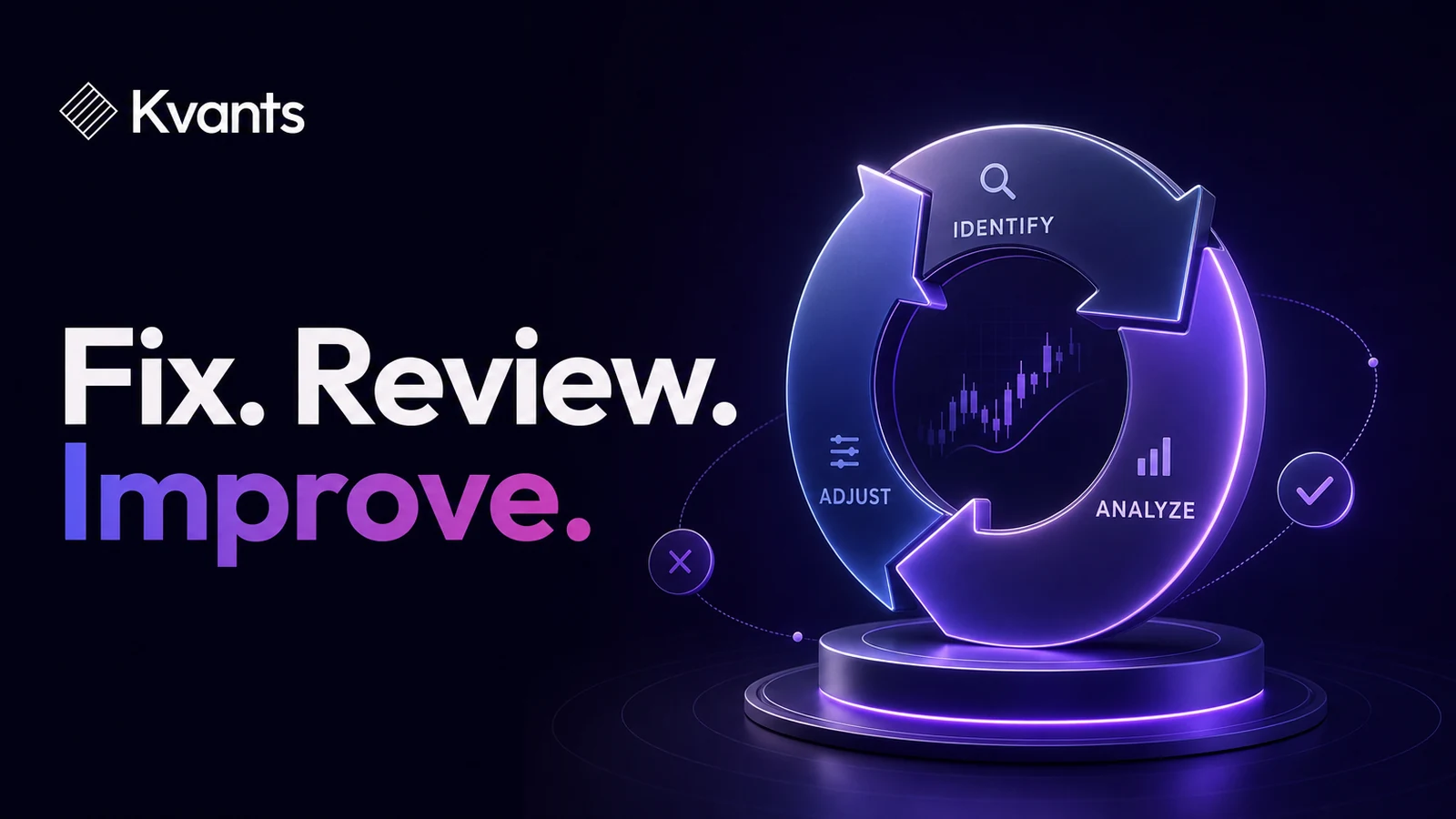
6. Run a defined correction period
Keep the chosen control stable for a predefined number of eligible opportunities or a suitable review period. Track whether the targeted behavior becomes less frequent and whether the control introduces a different problem.
Judge rule adherence first. Short-term financial results are noisy and may hide whether the intervention changed the behavior.
7. Keep, revise, or remove the control
Keep the control if it reduces the target mistake without making valid execution impractical. Revise it if it is easy to bypass or blocks legitimate trades. Remove it if the original diagnosis was wrong.
Then select the next highest-priority behavior. Changing several habits simultaneously makes it difficult to determine which intervention helped.
A strategy laid out end to end in the Kvants editor.
Worked Example: Entering Before Confirmation
Consider a trader whose setup requires a 15-minute candle to close above a defined range before entry. During review, the trader finds several orders submitted while the confirmation candle was still forming.
Calling the problem “impatience” is not enough. The observable mistake is:
An entry was submitted before the required 15-minute candle close confirmed the breakout.
The trader reviews every eligible setup, not just losing trades, and tags each entry as “confirmed” or “early.” The correction has three parts:
- Create an alert based on the completed-candle condition.
- Keep the order ticket closed until the alert triggers.
- Record compliance immediately after the trade.
The primary measurement is the percentage of eligible entries that followed the confirmation rule. If compliance improves but rule-based results remain weak across a meaningful sample, the diagnosis changes: the execution issue may be resolved, leaving a strategy question that requires separate testing.
Common Failure Modes
Reviewing only losing trades
This reinforces outcome bias. Review winning rule violations and losing rule-compliant trades under the same standard.
Using vague psychological labels
Fear, greed, and impatience may describe an experience, but they do not identify the action to change. Translate the label into visible behavior, timing, and context.
Changing the strategy after every mistake
An execution error does not automatically justify changing the setup. First determine what would have happened under the original rules.
Trying to remove normal uncertainty
No rule eliminates losses or drawdowns. Adding filters whenever a trade fails can produce a strategy tailored to past data rather than a durable hypothesis.
Tracking mistakes without intervening
A journal is not a correction system by itself. Each priority mistake needs a preventive control, observation period, and scheduled decision date.
Separate Strategy Problems From Execution Problems
Once a strategy can be expressed objectively, testing the intended rules can provide a baseline for comparison with actual decisions.
Kvants Studio turns plain-English trading ideas into editable, auditable strategy logic. It supports event-driven backtesting, parameter sweeps, walk-forward analysis, and crisis-stress validation. These tools can help investigate a narrow question: Does the specified strategy reveal a weakness, or is the larger gap between the specification and its execution?
Historical testing cannot capture every discretionary input, and its conclusions depend on data quality, costs, assumptions, and order logic. The Kvants documentation explains how to structure explicit strategy logic before running a test.
Kvants audits that the engine runs the strategy you configured.
Frequently Asked Questions
What are the most common trading mistakes?
Common mistakes include entering without required confirmation, trading outside the plan, using incorrect position size, moving an invalidation point, operating outside approved hours, and making unplanned exits. Focus on the behaviors that recur in your own records rather than a generic list.
How long does it take to correct a trading mistake?
There is no universal duration. Define a review point using enough eligible opportunities to observe the behavior repeatedly. Calendar time alone can be misleading when a setup occurs infrequently.
Should I stop trading while correcting a mistake?
It depends on severity. A documentation issue may be corrected during normal practice. Repeated violations involving leverage, stops, or loss limits may justify reducing size, returning to simulation, or pausing until an effective control is in place.
Can a winning trade still be a mistake?
Yes. A trade that violates the plan remains a process mistake even when its outcome is favorable. Treating the outcome as validation can reinforce behavior that creates greater future risk.
When should I change the strategy instead of my behavior?
Consider revising the strategy when its rules are explicit, execution is sufficiently consistent, assumptions are realistic, and a meaningful body of evidence shows that the rules are not behaving as intended. Test one specific revision rather than changing several variables at once.
Risk Note
This article is educational and is not investment advice. Trading involves risk, and process improvements cannot eliminate losses. Backtested performance does not guarantee future results. Kvants is a research tool, not an investment adviser. Test assumptions carefully, account for costs and execution uncertainty, and use risk limits appropriate to your circumstances.