Learn how event-driven backtesting processes signals, orders, and fills in sequence—and why data resolution, execution rules, and ambiguous bars still matter.
Quick Answer
Event-driven backtesting simulates a strategy by processing market data, signals, orders, fills, and portfolio updates as a sequence of time-stamped events. It is especially useful when trade order, position state, partial execution, or intrabar price movement can affect the result. Its main limitation is that the engine cannot reconstruct information absent from the historical data. An event-driven design improves sequencing, but realistic results still require suitable data, explicit execution rules, trading costs, and careful handling of ambiguous bars.
Key Takeaways
- Event-driven backtesting evaluates each event in chronological order instead of calculating every signal as one large batch.
- It is valuable when later decisions depend on earlier fills, cancellations, position changes, or risk checks.
- A sophisticated engine cannot determine whether a stop or target was hit first from an OHLC bar that touched both.
- Order types, fill timing, fees, spread, slippage, and data resolution must be specified independently.
- Vectorized testing remains useful for rapid research when execution sequencing is not central to the hypothesis.
- The correct engine is the one that represents the strategy’s actual decisions without adding unsupported precision.
What Event-Driven Backtesting Actually Does
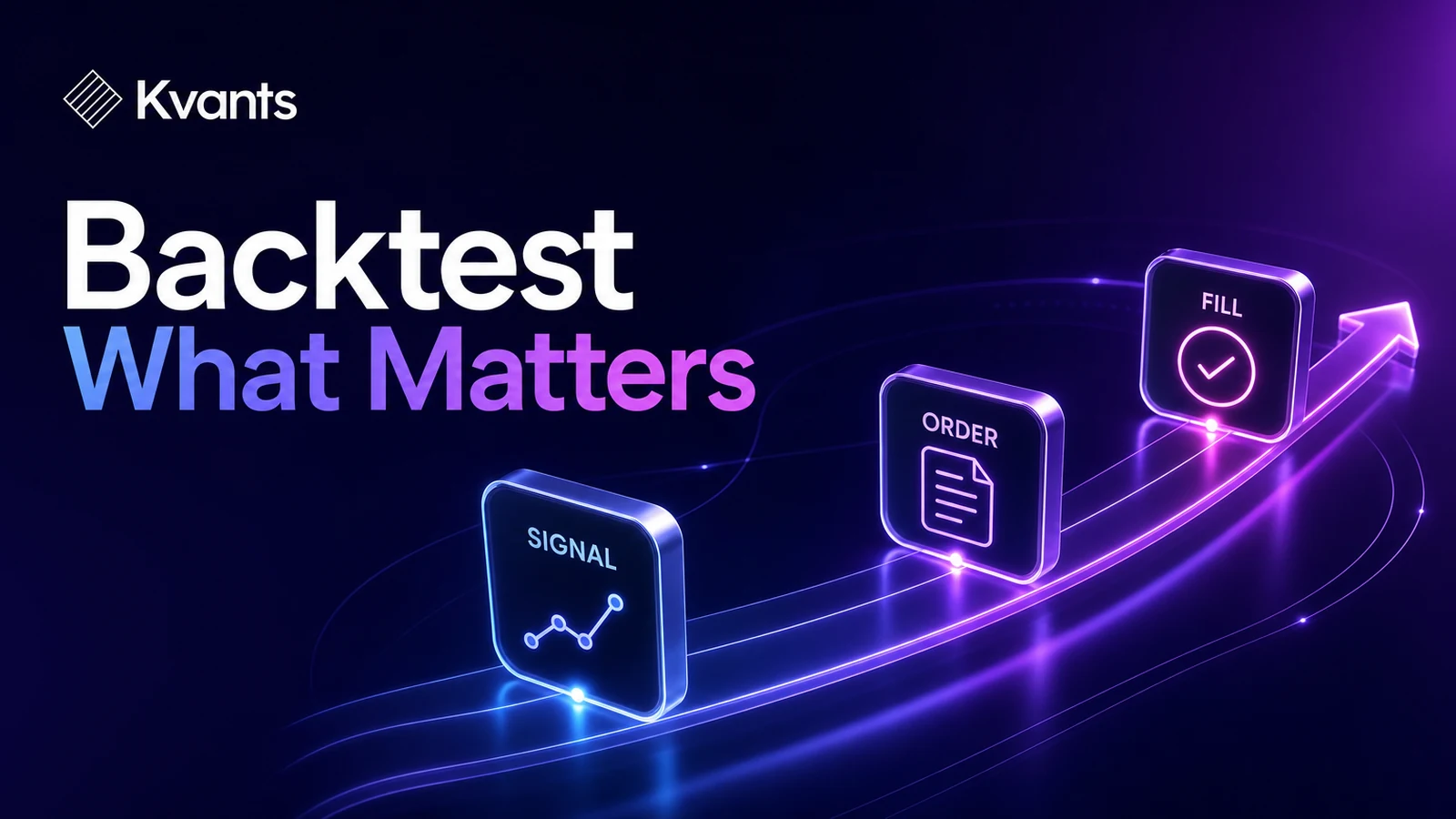
An event-driven backtest advances through historical data as if the strategy were receiving information over time. A simplified event loop might process:
- A new market-data event arrives.
- Indicators and strategy state update.
- The strategy generates a signal.
- Risk and position-sizing rules evaluate the signal.
- An order is submitted, modified, or cancelled.
- The execution model determines whether a fill occurs.
- Cash, positions, and open orders update.
- The engine moves to the next event.
This sequencing matters because trading decisions are state-dependent. A strategy cannot exit a position it has not entered. Capital committed to one order may be unavailable to another. A stop submitted after an entry fill should not protect the position before that fill exists.
“Event-driven” describes the simulation architecture, not the quality of every assumption. The engine may process events correctly while still using inadequate data or unrealistic fill rules.
Configuring a backtest in Kvants Studio.
Event-Driven Backtesting vs Vectorized Backtesting
Vectorized backtests typically calculate indicators and signals across complete arrays or table columns. They are efficient for testing ideas such as whether returns following a condition differ from a benchmark. Event-driven systems process observations sequentially and maintain changing portfolio and order state.
| Approach | Best For | Main Limitation |
|---|---|---|
| Vectorized backtesting | Fast signal research, broad screening, simple end-of-bar rules, and initial parameter exploration | Can make execution timing and state-dependent logic difficult to represent accurately |
| Event-driven backtesting | Order-sensitive strategies, portfolio constraints, stops, limit orders, scaling, and sequential risk rules | More assumptions, computation, and implementation complexity |
| Manual chart replay | Practising discretionary recognition and reviewing how a setup appeared over time | Slow, difficult to standardize, and vulnerable to inconsistent decisions |
There is no universal winner. A researcher might use vectorized analysis to reject weak hypotheses quickly, then move surviving ideas into an event-driven test. Manual replay may still help assess discretionary rules that have not yet been defined precisely enough to code.
Browsing tradeable signals in the research library.
Worked Example: When One Bar Produces Two Outcomes
Assume a strategy is already long at 100 with:
- A stop at 95
- A profit target at 105
- One historical bar with an open of 100, high of 106, low of 94, and close of 102
Both exit prices were touched during the bar. If the target occurred first, the trade exited at 105. If the market fell to 94 first, the stop was triggered before the later rally.
The OHLC bar does not reveal the path between its open, high, low, and close. Processing that bar through an event-driven engine does not magically identify the correct outcome.
A defensible test must choose and document a policy. Options include using lower-resolution data, applying a conservative stop-first rule, excluding ambiguous trades, or reporting results under both possible sequences. Each choice answers a slightly different research question.
This is why engine architecture and data granularity should not be confused. Event sequencing can prevent logical errors, but only the data can reveal the price path—and sometimes the available data cannot reveal it at all.
A Step-by-Step Event-Driven Backtesting Workflow
1. Write the decision timeline
For every rule, specify when its inputs become known and when an order may be submitted. A signal calculated from a completed daily close generally cannot receive a fill at that same close unless the strategy and data genuinely support an earlier decision.
Distinguish the signal timestamp, decision timestamp, order-submission timestamp, and potential fill timestamp.
2. Match data resolution to the strategy
Daily bars may be sufficient for a monthly rebalance executed at the next session’s open. They are less suitable for a strategy placing several intraday stops and targets.
Higher resolution is not automatically better. It increases data and computational requirements, and it still may not reproduce queue position or every market microstructure detail.
3. Define order semantics
State what happens to market, limit, stop, and stop-limit orders. Document when orders become active, whether they expire, how gaps are treated, and whether partial fills are possible.
Avoid silent assumptions. For example, a limit price touched by a bar is not necessarily a guaranteed fill in a real market.
4. Model costs separately
Include the costs relevant to the market and holding period, such as fees, spread, slippage, or financing. Do not use one arbitrary cost estimate as proof of robustness. Test a reasonable range and identify the point at which the strategy’s conclusions change.
5. Establish an ambiguity policy
Decide in advance how the backtest handles bars that touch multiple active orders, missing observations, market gaps, duplicate timestamps, or unavailable prices. Apply the policy consistently rather than selecting the favorable interpretation trade by trade.
6. Run small, inspectable tests
Before running years of history, create simple cases with known outcomes. Check that a signal cannot use future data, exits cannot precede entries, position size respects available capital, and rejected orders do not alter the portfolio.
Inspect individual trades around gaps, reversals, stop-outs, and simultaneous signals. Aggregate metrics can hide sequencing defects.
7. Test sensitivity and unseen periods
Vary uncertain assumptions such as slippage, execution delay, and ambiguous-bar policy. Then evaluate the fixed strategy on data not used to choose its rules. Parameter sweeps and walk-forward analysis can help, but they do not repair incorrect event timing.
A strategy laid out end to end in the Kvants editor.
Common Failure Modes
Same-bar signal and fill: A strategy uses the completed bar’s close to create a signal and also assumes execution at that close. This may introduce information the trader would not have had before the fill.
Guaranteed limit fills: Price touching a limit is treated as sufficient evidence of execution, ignoring gaps, liquidity, and queue priority.
Incorrect event priority: A newly created stop is allowed to trigger earlier within the same bar, before the entry that created it.
Hidden intrabar assumptions: The engine silently chooses whether the high or low occurred first, consistently favoring either the stop or target.
State updated before execution: The strategy calculates subsequent orders as though an unfilled or rejected order had already changed the position.
Precision beyond the data: Detailed execution logic creates an appearance of realism even though the source data contains only coarse bars.
The practical defense is an audit trail: preserve timestamps, order state, fill decisions, and the rule responsible for each action.
Applying the Workflow in Kvants
Kvants Studio turns plain-English trading ideas into editable, auditable strategy logic. Backtests run on NautilusTrader’s event-driven engine, allowing research logic to be evaluated as a sequence of market, order, fill, and portfolio events rather than only as static signal columns.
For stocks and crypto research, traders can use parameter sweeps, walk-forward analysis, and crisis-stress validation to examine whether conclusions survive changed assumptions and unseen periods. Strategies can also be exported to Pine Script v6 or moved into controlled paper and live workflows.
The engine does not remove the need to define execution timing or inspect ambiguous cases. Use the strategy logic and results together: verify when information becomes available, how orders are handled, and whether the data supports the claimed precision. Additional research material is available in the Kvants blog and implementation guidance in the Kvants documentation.
Frequently Asked Questions
Is event-driven backtesting more accurate than vectorized backtesting?
Not automatically. It can represent sequencing, order state, and portfolio constraints more explicitly. Accuracy still depends on data quality, timing rules, fill assumptions, costs, and implementation. A simple vectorized test may be entirely adequate for a simple next-bar strategy.
Does event-driven backtesting require tick data?
No. An event-driven engine can process daily, hourly, minute, trade, or quote events. The required resolution depends on the strategy. Coarse data remains unsuitable when the result depends on price movement hidden inside each observation.
Can event-driven testing eliminate look-ahead bias?
It can make correct time ordering easier to enforce, but it cannot guarantee the absence of look-ahead bias. Future-adjusted data, improperly calculated indicators, revised fundamentals, or same-bar execution assumptions can still leak future information into the test.
How should a backtest handle a stop and target hit in the same bar?
Use finer data if it reliably reveals the sequence. Otherwise, adopt a documented conservative rule, exclude the trade, or calculate both outcomes as a sensitivity range. Do not silently choose the favorable exit.
When is vectorized backtesting sufficient?
It is often sufficient for early hypothesis testing, cross-sectional analysis, simple end-of-period rebalancing, and strategies whose conclusions do not depend heavily on intrabar order sequence. Move to event-driven testing when execution state materially affects results.
Risk Note
This article is educational and is not investment advice. Backtested performance does not guarantee future results. Historical simulations simplify real execution and may omit liquidity constraints, market impact, data errors, operational failures, and changing market conditions. Kvants is a research tool, not an investment adviser, and does not guarantee performance.