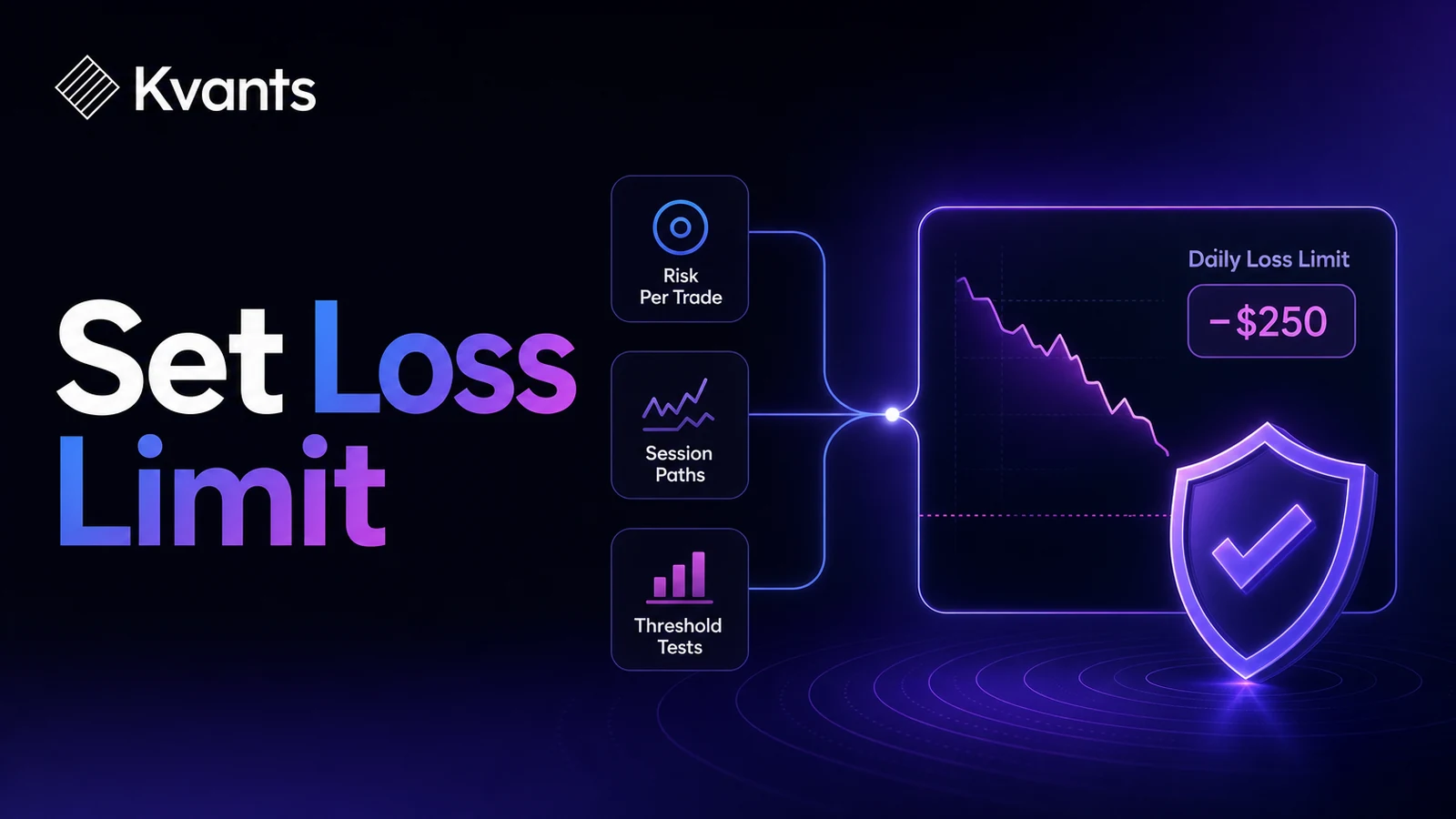
Learn how to set a daily trading loss limit from risk per trade, historical session paths, and threshold tests instead of relying on an arbitrary percentage.
Quick Answer
Set a daily trading loss limit by expressing session losses in R, where 1R is your planned risk per trade, and testing several limits against your strategy’s chronological trade sequence. A useful limit should contain unacceptable loss escalation without routinely blocking valid trades required by the strategy. There is no universal correct percentage: the appropriate threshold depends on trade frequency, overlapping exposure, execution costs, holding period, and whether unrealized losses count toward the limit.
Key Takeaways
- Define 1R and your normal per-trade risk before choosing a daily threshold.
- Specify whether realized losses, open losses, fees, and slippage count.
- Test several thresholds instead of adopting a standard percentage by default.
- Replay trades chronologically because stopping early removes later trades.
- Account for correlated positions and aggregate open risk.
- Keep the daily rule separate from emergency and account-level drawdown controls.
What a Daily Loss Limit Actually Controls
A daily loss limit is a session-level rule that restricts additional trading after losses reach a defined threshold. It sits between a stop-loss on one position and a broader account drawdown limit.
These controls solve different problems:
- Trade stop: Limits risk on one position.
- Daily loss limit: Contains damage from a sequence of trades or deteriorating execution.
- Account drawdown limit: Controls cumulative loss across multiple sessions.
- Emergency limit: Responds to exceptional events such as connectivity failures, unintended exposure, or abnormal execution.
A complete daily rule needs more than a dollar amount. It must define when the session starts and ends, which losses count, and what happens when the threshold is reached.
For example, “stop at minus 3R” remains ambiguous. Does it include unrealized P&L? Do commissions count? Are existing positions closed, or are only new entries prohibited? Can exposure be reduced? Does the calculation reset at midnight, at the exchange close, or at the beginning of the trader’s next planned session?
Resolve these questions before evaluating the rule.
Deploying a strategy to paper or live with a pre-flight gate.
How to Set a Daily Trading Loss Limit
1. Define risk per trade
Start with the maximum planned loss on a normal trade. Call this 1R.
If an account is $20,000 and planned risk per trade is $100, then:
1R = $100
A $200 daily limit equals 2R, while a $300 limit equals 3R. Expressing the limit in R makes it easier to compare across account sizes and instruments.
Use planned risk rather than average historical loss as the reference point. An average can conceal stop overruns, partial exits, and unusually small losses. Planned R gives the rule a stable base, provided the trader also measures deviations between planned and realized risk.
2. Define the loss calculation
Choose one calculation and apply it consistently. A cautious session P&L calculation might be:
Session P&L = realized P&L + unrealized P&L - fees - estimated exit costs
Open positions require special treatment. Looking only at realized P&L can permit new risk while existing positions are already losing. Counting every unrealized fluctuation, however, may trigger the limit during normal intraday movement.
One workable policy is:
- Use realized and unrealized P&L to decide whether new risk is permitted.
- Use position-specific stops and exits to determine when existing trades close.
This prevents additional entries without automatically overriding the strategy’s exit rules. A rule that immediately liquidates all positions at the daily threshold is also possible, but it is materially different and must be tested separately.
3. Define the session boundary
State exactly when the loss calculation resets. This is straightforward only when the strategy trades one regular market session and closes all positions before the end.
Additional rules are needed when the strategy:
- Trades extended hours
- Holds positions overnight
- Trades crypto continuously
- Operates in several time zones
- Trades markets with different session calendars
Choose a timezone and a specific reset event. For overnight positions, define whether subsequent gains and losses belong to the entry session, the current calendar day, or another risk window. The choice should reflect how exposure is actually managed.
4. Reconstruct historical session paths
Group historical trades by the chosen session and preserve their original order. For every session, record:
- Starting and ending P&L in R
- Maximum intraday loss
- Entry and exit sequence
- Simultaneous open risk
- Fees and estimated slippage
- Trades occurring after each candidate threshold
- Whether losses came from valid setups or rule violations
End-of-day P&L is not enough. A session that ends at +1R may have fallen to -3R before recovering. A 2R daily limit would have changed that path and removed at least some subsequent trades.
Intraday risk controls therefore require trade-level or event-level data rather than a table of daily closing results.
5. Test several candidate thresholds
Evaluate a range such as 1.5R, 2R, 3R, and 4R instead of selecting one threshold immediately. For each candidate, stop accepting new entries when the threshold is breached and recalculate the session from that point forward.
Compare more than the final net result. Examine:
- Maximum drawdown
- Average and worst session loss
- Number of sessions stopped
- Number and type of trades excluded
- Positive trades missed after the stop
- Change in expectancy and trade count
- Sensitivity to higher fees and slippage
A tight limit can reduce severe individual days while damaging a strategy whose normal trade distribution includes several consecutive losses. A wide limit preserves more opportunities but may fail to constrain the behavior or exposure that motivated the rule.
Look for a stable range rather than the single threshold with the strongest historical result. If a small change from 2.75R to 3R completely changes the conclusion, the apparent optimum may be fragile.
6. Check correlated and overlapping exposure
Risk per trade does not equal total portfolio risk. Three positions risking 1R each may behave like one concentrated 3R position if all depend on the same market move.
Define whether the daily rule considers:
- Realized session P&L
- Current unrealized P&L
- Remaining risk to each stop
- Aggregate open risk
- Exposure shared across correlated instruments
Strategies that scale into positions, trade related assets, or hold several positions simultaneously need portfolio-aware logic. Otherwise, a daily limit can appear conservative while allowing substantial common exposure.
7. Write the operational rule
Turn the selected threshold into an instruction that can be followed without interpretation. For example:
If session P&L, including realized results, unrealized losses, fees, and estimated exit costs, reaches -3R, no new positions may be opened until the next defined session. Existing positions remain governed by their original stop and exit rules. Exposure may be reduced but not increased.
This is a template, not a universal recommendation. A strategy that closes every position at the threshold requires different wording and a separate test.
A backtest's equity curve and trade-by-trade log.
Worked Example: Testing a 3R Session Limit
Assume a trader has a $20,000 account and plans to risk $100 per trade. Therefore, 1R equals $100. The trader is considering a maximum daily loss of $300, or 3R.
One hypothetical session contains this sequence:
- Trade one loses 1R.
- Trade two loses 0.8R after slippage.
- Trade three loses 1.2R.
- A later valid setup gains 2R.
After trade three, session P&L has reached -3R. Under a rule that prohibits new positions at that point, trade four cannot be taken. The session remains near -3R instead of recovering to -1R.
This does not prove the limit is unsuitable. On another day, the same rule might prevent several additional losses. The example shows why an analyst cannot remove losses occurring beyond the threshold while retaining winners that came later. The entire sequence must be replayed with the rule active.
The trader should apply the 3R threshold across many sessions, compare it with tighter and wider alternatives, and inspect the excluded trades. The analysis should also consider whether those sessions reflect the current strategy, sizing method, and execution process.
Common Failure Modes
Choosing a percentage by convention
A familiar percentage is not automatically appropriate. The same 2% daily limit behaves differently for a strategy risking 0.25% per trade than for one risking 1% per trade.
Ignoring unrealized exposure
A realized-loss-only rule can allow new trades while open positions already place the session beyond its intended risk budget.
Testing only daily closing P&L
Daily totals hide the order of entries, exits, and intraday losses. Session limits require chronological data because the rule changes which later trades can occur.
Mixing strategy losses with execution violations
A valid setup that loses and a trade that violates the plan require different diagnoses. Tag stop movement, impulsive re-entry, excessive size, and invalid setups separately. A tighter daily limit may contain damage, but it cannot repair unclear entry criteria or repeated rule-breaking.
Optimizing for one historical threshold
Choosing the exact threshold with the strongest past result invites overfitting. Prefer a region where nearby limits produce broadly similar behavior, then examine that region on unseen periods and difficult market conditions.
Using an ambiguous reset rule
A rule cannot be enforced consistently if “day” has not been defined. Specify the timezone, session boundary, treatment of extended hours, and assignment of overnight P&L.
Validating the Rule Before Use
A daily limit changes strategy behavior, so it should be tested as part of the strategy rather than added after reviewing summary results.
In Kvants Studio, traders can express session-level risk rules as editable, auditable strategy logic and test them with NautilusTrader’s event-driven engine. Parameter sweeps can compare candidate R thresholds, while walk-forward and crisis-stress validation can help identify whether a chosen limit depends too heavily on one historical period.
Review order handling, session boundaries, open-position treatment, and cost assumptions carefully. Guidance for building and inspecting strategy logic is available in the Kvants Studio documentation. Kvants is a research tool; the trader remains responsible for deciding whether the assumptions represent realistic execution and suitable risk constraints.
A strategy laid out end to end in the Kvants editor.
Frequently Asked Questions
What is a reasonable daily trading loss limit?
There is no universal number. A reasonable limit constrains unacceptable session risk without routinely interrupting the strategy’s normal loss distribution. Define candidate limits in R and test them against chronological trades.
Should a daily loss limit include unrealized losses?
Unrealized losses should generally affect whether additional risk can be added. Whether they trigger immediate liquidation is a separate decision. Forced liquidation can conflict with a strategy’s normal exits and should be evaluated independently.
Does the daily limit reset after a winning trade?
Not automatically. A fixed limit based on starting session equity differs from a trailing rule that changes as session equity rises. Define the method in advance. Restoring the full allowance after each gain can permit a larger total session loss than intended.
Is a daily loss limit the same as maximum drawdown?
No. A daily limit governs one defined session. Maximum drawdown measures the decline from an equity peak across sessions. A trading plan may use both because they address different risk horizons.
Should reaching the limit close every open position?
Not necessarily. One policy can prohibit new entries while existing positions follow their original exits. Another can liquidate all exposure immediately. These rules create different trade paths and should not be evaluated as if they were interchangeable.
How often should the limit be reviewed?
Review it when position sizing, strategy logic, trade frequency, instruments, execution costs, or session structure changes. Avoid changing the threshold in response to a small cluster of recent losses without enough evidence to distinguish normal variation from a lasting change.
Risk Note
This article is educational and is not investment advice. Trading involves risk, and daily limits cannot prevent losses, price gaps, slippage, or operational failures. Backtested performance does not guarantee future results. Test assumptions carefully and use risk levels appropriate to your circumstances.