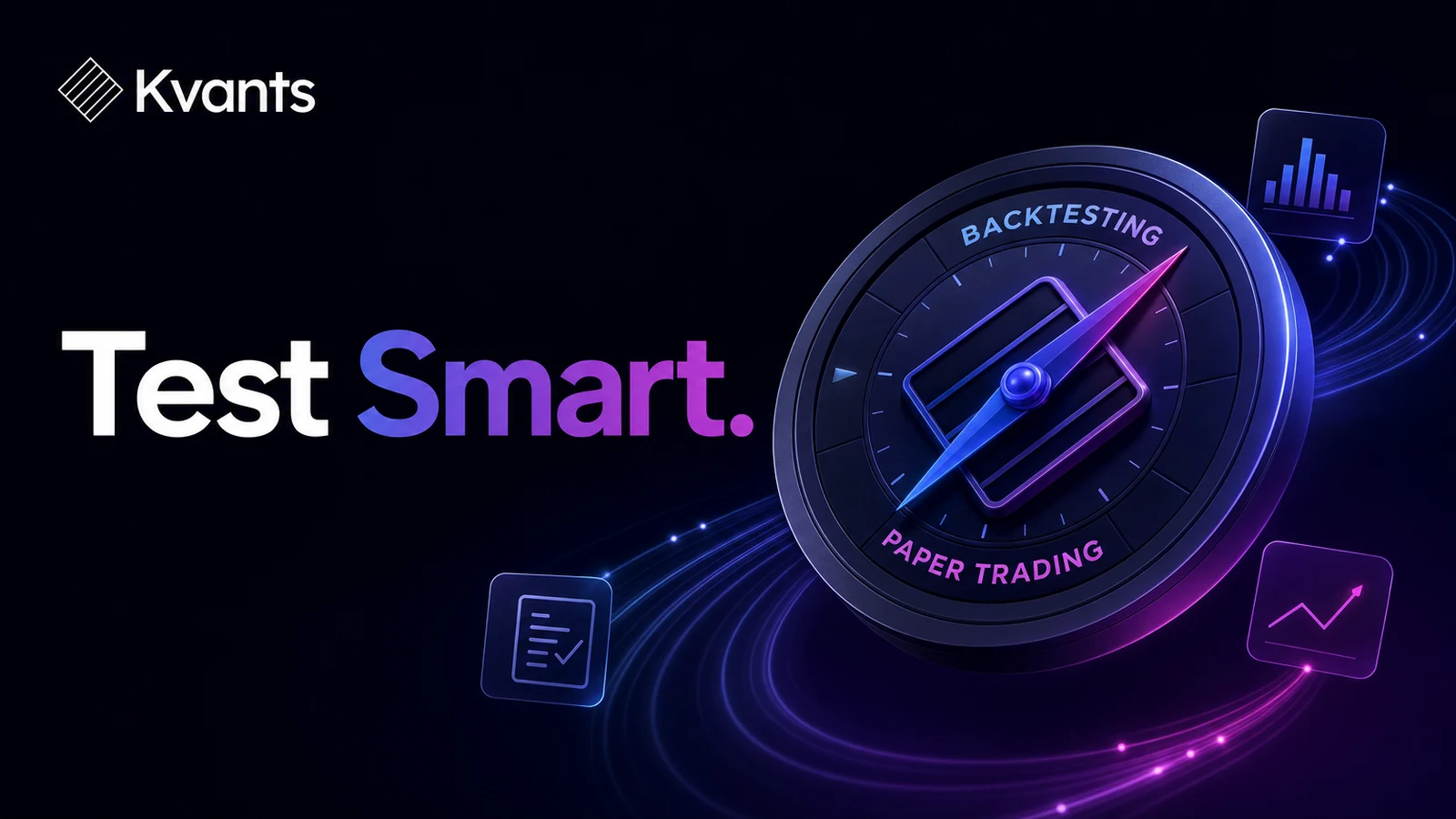
Compare backtesting vs paper trading, understand what each method can validate, and follow a practical workflow for moving a strategy toward live execution.
Quick Answer
Backtesting applies fixed strategy rules to historical data, while paper trading tests those rules prospectively in a simulated account. Use backtesting first to examine a larger set of market conditions, then paper trade to evaluate signal timing, order handling, data availability, and your ability to follow the process in real time.
Neither method proves that a strategy will work with real money. A backtest depends on its assumptions, and paper trading cannot fully reproduce live fills, liquidity, latency, or emotional pressure.
Key Takeaways
- Backtesting tests historical strategy behavior; paper trading tests forward execution without capital at risk.
- A backtest can cover more trades and market regimes quickly, but modeling errors can make its results unrealistic.
- Paper trading reveals operational problems that historical reports may hide, including delayed decisions and incorrect orders.
- Paper fills are simulations and may be more favorable than fills available in a live market.
- The strongest process usually uses both methods, with explicit pass, revise, and stop criteria at each stage.
- A strategy should move forward because its rules and evidence are acceptable—not because one headline metric looks impressive.
Backtesting vs Paper Trading: The Core Difference
The main difference is when the test happens.
A backtest moves through recorded market data and asks: “What would these rules have done if they had been applied at the time?” Depending on the system, years of data may be processed in minutes.
Paper trading runs in present time. The trader or software receives current market data, generates decisions, and submits simulated orders as new information arrives. You cannot skip ahead, so collecting observations may take weeks or months.
This makes the methods complementary rather than interchangeable. Backtesting is mainly a research tool. Paper trading is mainly a forward-testing and operational rehearsal tool.
The distinction also prevents a common mistake: treating every simulated result as equivalent evidence. A historical simulation with unrealistic fills is weak evidence. A short paper-trading run containing only favorable market conditions is also weak evidence. The quality of the test matters as much as its label.
What Each Method Can Actually Validate
Backtesting is useful for determining whether a precisely defined idea deserves further investigation. It can help answer questions such as:
- How often did valid signals occur?
- How did results vary across assets, years, and market regimes?
- What drawdowns and losing sequences appeared historically?
- How sensitive were results to fees, slippage, and parameter changes?
- Did the apparent edge persist outside the period used to design the rules?
Backtesting is less reliable when the rules are subjective, the required data were unavailable at decision time, or the fill model ignores market mechanics.
Paper trading addresses a different group of questions:
- Do signals arrive early enough to act on them?
- Are orders formed with the correct side, size, type, and price?
- Does the strategy depend on data that are delayed or occasionally missing?
- Can the trader follow the rules consistently during a live session?
- Do forward observations remain broadly compatible with the tested behavior?
Paper trading still cannot fully validate market impact, queue position, partial fills, broker-specific behavior, or the psychological effects of risking money. Those limitations become more important for larger orders, less-liquid assets, and strategies that depend on rapid execution.
A strategy laid out end to end in the Kvants editor.
Comparison by Research Goal
| Method | Best For | Main Limitation |
|---|---|---|
| Backtesting | Exploring historical behavior across many trades and market conditions | Results depend on data quality, timing logic, and execution assumptions |
| Paper trading | Testing current signals, workflow reliability, and order handling | Simulated fills and short observation periods may not represent live trading |
| Small controlled live test | Observing real fills, costs, and decision pressure at limited exposure | Capital is at risk, and a small sample cannot establish long-term robustness |
There is no universal winner. The appropriate method depends on the question being tested. Historical robustness cannot be established from a few paper trades, while operational readiness cannot be established from an equity curve alone.
A backtest's equity curve and trade-by-trade log.
Worked Example: A Daily Breakout Strategy
Suppose a trader defines this stock strategy:
- Enter long when price closes above the previous 20-day high.
- Place the decision after the daily bar closes.
- Enter at the next session’s open.
- Set an initial stop one average true range below entry.
- Exit after ten sessions or when the stop is triggered.
- Risk a fixed fraction of account equity per trade.
The backtest should first enforce the timeline. The breakout is known only after the close, so the test cannot fill the trade at that same closing price unless a valid order process makes that possible. A next-open assumption is more consistent with the stated rules.
The trader then examines results across different periods and stocks, includes estimated costs, and checks whether small parameter changes destroy the outcome. Walk-forward testing can separate strategy development from evaluation on later, unseen periods.
If the historical evidence remains acceptable, the strategy enters paper trading. The trader now checks whether the daily data arrive correctly, the signal is generated after the close, position size uses the intended stop distance, and the simulated order is ready for the next session.
Assume a paper order appears with twice the expected quantity. That does not necessarily invalidate the breakout concept. It identifies an implementation error in the position-sizing process. Conversely, perfectly formed paper orders do not rescue a strategy whose historical results depended on one unusually favorable period.
Each stage is answering a different question.
A Step-by-Step Validation Workflow
1. Convert the idea into testable rules
Define the instrument universe, data interval, entry condition, decision time, order timing, exit logic, sizing rule, and treatment of overlapping signals. Replace phrases such as “strong breakout” or “healthy trend” with observable conditions.
2. Build a timing-correct backtest
Separate the signal time, decision time, order submission time, and possible fill time. Include commissions, spread or slippage assumptions, and any trading constraints relevant to the strategy.
For intrabar strategies, data resolution matters. A daily bar usually cannot reveal whether a stop or target was touched first when both prices fall inside the same bar.
3. Test robustness, not just the best configuration
Compare nearby parameter values, different assets, distinct market periods, and unseen evaluation windows. Consider crisis or stress periods if they are relevant to the holding period and risk model.
The goal is not to find parameters that make the past look best. It is to determine whether the strategy’s behavior is stable enough to justify a forward test.
4. Define paper-trading acceptance criteria
Write down what the paper stage must demonstrate before it begins. Criteria might include correct signal timing, accurate position sizing, no invalid orders, reliable data processing, and complete records of discrepancies.
Avoid using only a profit target. A strategy can lose during a short forward window while operating exactly as designed, or make money despite serious implementation errors.
5. Reconcile every paper trade
For each signal, compare the expected action with the simulated action. Record missed signals, duplicate orders, rejected orders, sizing differences, timing delays, and fill discrepancies.
Classify each difference as a strategy-rule issue, software issue, data issue, execution assumption, or operator error. This is more actionable than reviewing total simulated profit and loss alone.
6. Decide whether to revise, continue, or stop
A rule change sends the strategy back to research and historical testing. An implementation defect should be corrected and retested. If the paper process is reliable but the sample is too narrow, continue collecting observations rather than forcing a conclusion.
If a strategy eventually moves to live trading, use limited, predefined exposure and rollback rules. Live trading is another validation stage, not confirmation that future performance is assured.
Common Failure Modes
Optimizing after every paper loss
Changing parameters in response to one or two losing trades turns forward testing into continuous curve-fitting. Compare outcomes with the strategy’s expected range of variation before modifying the rules.
Treating paper fills as executable prices
A simulator may fill a limit order because the market touched its price. A live order might have remained behind other orders in the queue or received only a partial fill. Strategies sensitive to small price differences need conservative assumptions.
Comparing different strategy versions
If the historical test uses one entry rule but the paper account uses discretionary overrides, the results are not directly comparable. Assign versions to the rules and document every change.
Using too little historical diversity
A large number of trades from one market regime is not the same as broad evidence. Review results across trends, declines, volatile periods, and quieter conditions when those environments are relevant to the strategy.
Ignoring opportunity availability
A quiet paper-trading month may produce few valid signals. That is information about strategy frequency, but it may not be enough to judge outcome behavior. Test duration should reflect how often the setup occurs, not an arbitrary number of calendar days.
Applying the Workflow in Kvants
In Kvants Studio, a plain-English trading idea can be converted into editable, auditable strategy logic. Traders can inspect the rules rather than treating generated logic as a black box.
Historical tests run on NautilusTrader’s event-driven engine. Parameter sweeps, walk-forward analysis, and crisis-stress validation can help examine whether a result depends on a narrow configuration or period. Once the research criteria are met, the strategy can move through controlled paper and live workflows. Pine Script v6 export is also supported when that fits the intended workflow.
The important point is sequencing: define the rules, test historical behavior, challenge robustness, verify forward operation, and only then consider limited deployment. The Kvants blog provides additional material on backtesting, risk, and strategy validation.
Kvants audits that the engine runs the strategy you configured.
Frequently Asked Questions
Is paper trading better than backtesting?
Not in general. Paper trading is better for testing real-time workflow and order handling. Backtesting is better for examining more historical trades and conditions. Each method covers weaknesses in the other.
How long should I paper trade a strategy?
There is no reliable universal duration. Base the decision on opportunity count, market diversity, and the questions being tested. An infrequent strategy may require a longer calendar period than an active one, even if both need similar operational checks.
Can I skip paper trading after a strong backtest?
Skipping it leaves signal generation, data handling, sizing, and order construction untested in forward conditions. Even a carefully designed backtest does not establish that the operational workflow functions correctly.
Can paper trading replace out-of-sample testing?
Usually not. Paper trading creates forward observations, but collecting enough trades and market regimes may take a long time. Historical out-of-sample and walk-forward tests can evaluate broader periods, while paper trading tests current implementation.
Why do live results differ from paper results?
Live orders face actual spreads, liquidity, queue position, partial fills, latency, fees, and market impact. Traders may also behave differently when capital is at risk. These differences can be especially significant for fast or capacity-constrained strategies.
Risk Note
This article is educational and is not investment advice. Backtested performance does not guarantee future results. Paper trading also cannot reproduce every live-market condition. Kvants is a research tool, not an investment adviser, and no testing process can eliminate trading risk.